10 Best Generators for Power Outages (November 2026)
The best generators for power outages include the Westinghouse 14500W Tri-Fuel for broad home backup, the Westinghouse 13500W Tri-Fuel for flexible fuel planning, and the Westinghouse 12500W Tri-Fuel for selected essential circuits.
On this page (9 sections)
- How we chose the best generators for power outages
- Which generators suit different outage plans?
- How should you size a generator for a power outage?
- What fuel should you choose for outage backup?
- Should you choose an inverter or an open-frame generator?
- How do you connect a generator to home circuits?
- Where should you run a generator during an outage?
- How should you prepare and care for an outage generator?
- Which generator should you choose for your next power outage?
The Westinghouse 14500W Tri-Fuel is the best generator for power outage backup for households that need substantial output and several fuel choices. For a short list of essentials, a smaller inverter can be easier to move and manage.
Start with the appliances you must keep running, not the largest number on the generator's name. Refrigeration, a sump pump and a few lights call for a different setup from electric heating and central air conditioning.
Our guide to portable generators and their main types explains the main designs. Use the generator sizing guide to turn your appliance list into a buying target.
Our picks at a glance
-
1

-
2

-
3

- 4
 Best for stored fuel backupCheck it
- 5
 Best for busy household circuitsCheck it
- 6
 Check it
Westinghouse 8200W Tri-Fuel Inverter
Best for quieter essential backup - 7
 Best for a few essentialsCheck it
- 8
 Check it
Westinghouse 12000W Tri-Fuel Inverter
Best for larger inverter backup - 9
 Best for demanding home circuitsCheck it
- 10
 Best for extensive backup plansCheck it
How we chose the best generators for power outages
We prioritized usable output, fuel options and home connections, then weighed starting methods, inverter features and movement needs. StalwartStore compared the specifications for these outage use cases.
The order favors broad household usefulness rather than maximum capacity. A very large generator ranks lower when its weight and installation needs make it a poor match for a typical essentials plan.
The names emphasize peak watts, but continuous operation depends on running watts. Propane and natural gas can also deliver less output than gasoline, so the fuel you plan to use belongs in the calculation.
| Product | Best for | Running watts | Fuel | Home connection | Our score |
|---|---|---|---|---|---|
| Westinghouse 14500W Tri-Fuel | broad home backup | 11,500 on gasoline | Gasoline, propane or natural gas | 30A and 50A outlets | 9.2 |
| Westinghouse 13500W Tri-Fuel | flexible fuel planning | 10,500 on gasoline | Gasoline, propane or natural gas | 30A and 50A outlets | 9.1 |
| Westinghouse 12500W Tri-Fuel | selected essential circuits | 9,500 on gasoline | Gasoline, propane or natural gas | 30A and 50A outlets | 8.9 |
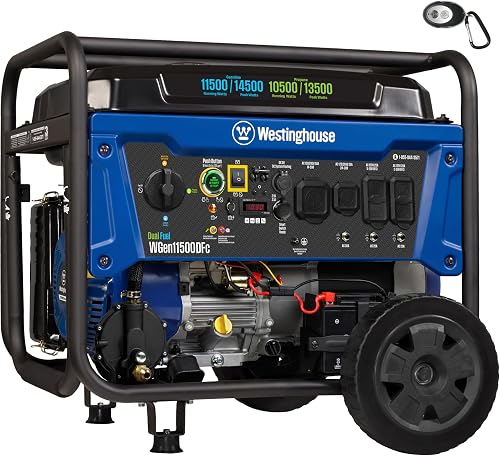
| Westinghouse 13500W Dual Fuel | stored fuel backup | 10,500 on gasoline | Gasoline or propane | 30A and 50A outlets | 8.7 |
| Westinghouse 14500W Dual Fuel | busy household circuits | 11,500 on gasoline | Gasoline or propane | 30A and 50A outlets | 8.4 |
| Westinghouse 8200W Tri-Fuel Inverter | quieter essential backup | 6,600 on gasoline | Gasoline, propane or natural gas | 120/240V 50A outlet | 8.3 |
| BILT HARD 4500W Dual Fuel | a few essentials | 3,500 on gasoline | Gasoline or propane | 7.9 | |
| Westinghouse 12000W Tri-Fuel Inverter | larger inverter backup | 9,000 on gasoline | Gasoline, propane or natural gas | 120/240V 30A and 50A outlets | 7.9 |
| Westinghouse 18000W Tri-Fuel | demanding home circuits | 14,500 on gasoline | Gasoline, propane or natural gas | 30A and 50A outlets | 7.6 |
| Westinghouse 28000W Tri-Fuel | extensive backup plans | 20,000 on gasoline | Gasoline, propane or natural gas | 7.0 |
Which generators suit different outage plans?
Choose an open-frame model for a larger load plan, an inverter when its output and noise features suit your household, or the BILT HARD for limited plug-in backup. Each pick below has a clear buyer and a reason to skip it.
Westinghouse 14500W Tri-Fuel: best generator for broad power outage backup
Westinghouse 14500W Tri-Fuel: Best for broad home backup
- 11,500 running watts on gasoline
- Gasoline, propane or natural gas
- Remote and push-button start
- CO sensor
A strong choice for households with several essential circuits and more than one fuel source. Its high gasoline output leaves more room for overlapping loads than the smaller picks.
Pros
- Three fuel options
- Remote and push-button start
- Less than 5% THD
Cons
- 230 lb weight
- Compatible home transfer equipment sold separately
Choose this for several essential home circuits when you also want options if one fuel becomes hard to obtain. Its 11,500 running watts on gasoline make it the strongest all-around starting point in this group.
The 30A and 50A outlets support compatible home transfer equipment. Westinghouse also supports pairing it with the separately sold WATS200 automatic transfer switch, which needs a planned installation.
Westinghouse claims up to 19 hours at 25% load from the 9.5-gallon gasoline tank. A heavier household load will change that refueling schedule, so don't plan overnight coverage around that figure alone.
Its pressure lubrication system and reusable oil screen are worth noting for buyers preparing for repeated outages. Follow the maintenance schedule even when the engine seems to run normally.
Skip it if your essential loads fit a compact inverter or you cannot move a 230 lb machine to a safe operating spot. More capacity has little value if setup is too difficult.
Westinghouse 13500W Tri-Fuel for a defined household load plan
Westinghouse 13500W Tri-Fuel: Best for flexible fuel planning
- 10,500 running watts on gasoline
- Gasoline, propane or natural gas
- Remote, push-button and recoil start
- CO sensor
Choose this for a defined circuit plan that fits below the top pick's capacity. Three fuel choices and three starting methods give you options during an outage.
Pros
- Three fuel options
- Three starting methods
- Automatic low-oil shutdown
Cons
- 230 lb weight
- No weight advantage over the top pick
This model suits buyers whose circuit calculation fits 10,500 running watts on gasoline and who want to keep natural gas available as an option. Choose it by that load fit rather than its peak-watt name.
Remote, push-button and recoil starting provide several ways to get the engine going. Recoil start is useful as another starting method, but it doesn't remove the need to care for the starting battery.
The fuel gauge and hour display help with two routine jobs: checking fuel before dark and tracking service during a long outage. Keep a written maintenance log beside your supplies.
Its gasoline output is below the top pick's, but both weigh the same. This is a capacity choice, not a way to make moving the generator easier.
Skip it if large motors push your plan beyond its limits, or if natural gas offers no practical benefit. The dual-fuel counterpart deserves consideration for a stored-fuel plan.
Westinghouse 12500W Tri-Fuel for selected essential circuits
Westinghouse 12500W Tri-Fuel: Best for selected essential circuits
- 9,500 running watts on gasoline
- 8,500 running watts on propane
- 7,500 running watts on natural gas
- CO shutdown
A fit for households that will manage selected circuits rather than leave every appliance available. Account for its lower output on propane and natural gas.
Pros
- Three fuel options
- Remote, electric and recoil start
- Digital hour meter
Cons
- 215 lb weight
- Natural gas output is lower than gasoline output
Choose this when you're willing to manage a defined group of circuits instead of leaving every appliance available. It provides 9,500 running watts on gasoline, 8,500 on propane and 7,500 on natural gas.
Those fuel differences matter if your plan just fits on gasoline. Build the plan around natural gas output if that will be your main supply, rather than treating it as equal backup capacity.
Remote, electric and recoil starting are included, along with an hour meter. Westinghouse claims up to 12 hours from its 6.6-gallon gasoline tank, though actual duration depends on demand.
This model weighs 215 lb, so its lower capacity does not make it a carryable generator. Check the route from storage to the operating spot for steps, soft ground and narrow gates.
Skip it if your priority is inverter operation or if a necessary motor cannot start within its capacity. A smaller circuit list can help, but required equipment must still start reliably.
Westinghouse 13500W Dual Fuel for stored gasoline and propane
Westinghouse 13500W Dual Fuel: Best for stored fuel backup
- 10,500 running watts on gasoline
- Gasoline or propane
- Remote, push-button and recoil start
- CO sensor
A practical match for a household planning around stored gasoline and propane. Choose a tri-fuel alternative if a natural gas connection is part of your plan.
Pros
- Two fuel options
- Three starting methods
- Automatic low-oil shutdown
Cons
- No natural gas operation
- 230 lb weight
This is a sensible choice when your backup plan uses fuel you keep on hand. It offers 10,500 running watts on gasoline and propane operation without requiring a natural gas connection.
Remote, push-button and recoil starts give you several startup options. The pressure lubrication system and reusable oil screen also make scheduled oil care part of preparation for repeated use.
Westinghouse claims up to 19 hours at 25% load on the 9.5-gallon gasoline tank. Work out how you will obtain more fuel if roads, stores or fuel pumps are unavailable.
The 30A and 50A outlets suit compatible home connection equipment. A CO sensor and low-oil shutdown add protection, while safe placement and regular checks remain your responsibility.
Skip this model if piped natural gas is central to your outage plan. Also skip it if you need a weight reduction: it weighs 230 lb, like several larger-capacity choices here.
Westinghouse 14500W Dual Fuel for overlapping household loads
Westinghouse 14500W Dual Fuel: Best for busy household circuits
- 11,500 running watts on gasoline
- Gasoline or propane
- Less than 5% THD
- CO sensor
This fits larger gasoline-powered load plans when natural gas access is unnecessary. Its gasoline running output matches the top pick.
Pros
- Substantial gasoline running output
- Less than 5% THD
- Remote and push-button start
Cons
- No natural gas operation
- 230 lb weight
Choose this when your gasoline load calculation needs 11,500 running watts and propane is your alternate fuel. It matches the top pick's gasoline capacity without adding natural gas operation.
The extra room over the smaller dual-fuel model can help when essential loads overlap. Still, a refrigerator or pump starting while another motor runs must fit within the generator's starting capability.
Westinghouse specifies less than 5% THD, and the generator includes remote and push-button start. Its CO sensor shuts the engine down when it detects high carbon monoxide.
At 230 lb, this belongs on a route you can manage before the power fails. Wheels help on suitable surfaces, but they do not solve stairs or a steep, muddy yard.
Skip it if your house plan fits a smaller machine or requires natural gas. Don't select it simply to avoid managing loads; electric heating and other large appliances still need their own calculations.
Westinghouse 8200W Tri-Fuel Inverter for quieter essential backup
Westinghouse 8200W Tri-Fuel Inverter: Best for quieter essential backup
- 6,600 running watts on gasoline
- Gasoline, propane or natural gas
- Less than 3% THD
- Remote and electric start
An inverter option for a controlled group of essential loads. It combines three fuel choices with less weight than the larger home backup picks.
Pros
- Three fuel options
- Less than 3% THD
- Enclosed inverter design
Cons
- 134.5 lb weight
- Lower output on propane and natural gas
This inverter suits households that will limit backup to essentials and value lower noise. It delivers 6,600 running watts on gasoline, 5,940 on propane and 5,280 on natural gas.
Westinghouse reports around 60 dBA at 25% load. That is a light-load figure, so expect sound to change as the engine supplies more power.
Its less than 3% THD output suits electronics, while the 120/240V 50A outlet allows a compatible home connection. The outlet's amp label does not increase the generator's total available watts.
Westinghouse claims up to 17 hours at 25% load from the 3.9-gallon gasoline tank. Its 134.5 lb weight is lower than the larger home backup picks, though it still needs a suitable movement route.
Skip it if a required 240V appliance or motor startup exceeds its capacity. Choose the larger inverter below when your load list needs more power and inverter features remain a priority.
BILT HARD 4500W Dual Fuel for limited plug-in essentials
BILT HARD 4500W Dual Fuel: Best for a few essentials
- 3,500 rated watts on gasoline
- 3,200 rated watts on propane
- Less than 3% THD
- CO sensor
Choose this small inverter for a limited group of plug-in essentials. Its 120V outlets and recoil start require a different plan from the larger home backup models.
Pros
- Lower weight than the other picks
- Propane hose and regulator included
- Less than 3% THD
Cons
- No 240V output
- Recoil start
Choose the BILT HARD for a small set of plug-in appliances when storage space and movement matter. It supplies 3,500 rated watts on gasoline or 3,200 on propane and weighs 57.7 lb.
A refrigerator, lights and communication devices are a possible use case only after you check their combined demand. Add appliances one at a time, and leave room for the refrigerator's compressor to start.
This inverter provides less than 3% THD and includes a propane hose with regulator. Its household and TT-30R outlets are 120V, so it cannot supply a 240V well pump or similar load.
Recoil start means you'll need to pull the starter cord. Consider whether that is manageable for the person who will set it up during an outage.
Skip it for broad circuit coverage or large electric heating loads. Its parallel capability requires a separate kit and compatible equipment, so treat expansion as another purchase and setup decision.
Westinghouse 12000W Tri-Fuel Inverter for larger inverter loads
Westinghouse 12000W Tri-Fuel Inverter: Best for larger inverter backup
- 9,000 running watts on gasoline
- 8,100 running watts on propane
- 7,200 running watts on natural gas
- Remote and electric start
A larger inverter for households whose essential circuits exceed the smaller inverter's capacity. Its display includes power output and remaining runtime.
Pros
- Three fuel options
- Low-THD inverter output
- Fuel and output information on the display
Cons
- 191 lb weight
- Less gasoline output than the top five picks
Choose this when the smaller inverter falls short but you still want inverter operation. It offers 9,000 running watts on gasoline, 8,100 on propane and 7,200 on natural gas.
Its low-THD output and 120/240V 30A and 50A outlets support a planned home backup setup. The display shows power output, fuel level and remaining runtime, helping you see how your selected loads affect operation.
Westinghouse reports sound as low as 64 dBA and claims up to 19 hours at 25% load from the 7.9-gallon tank. Neither figure describes every load condition.
The remote start and included battery charger are useful for preparation, but the starting battery still needs attention during storage. At 191 lb, moving it remains a serious part of ownership.
Skip it if maximum output matters more than inverter features. It also won't solve a load plan that exceeds its natural gas capacity, even if that plan fits on gasoline.
Westinghouse 18000W Tri-Fuel for demanding home circuits
Westinghouse 18000W Tri-Fuel: Best for demanding home circuits
- 14,500 running watts on gasoline
- Gasoline, propane or natural gas
- Less than 5% THD
- CO sensor
Consider this when a detailed load calculation exceeds the smaller generators' capacity. Its size and weight make site access part of the buying decision.
Pros
- High gasoline running output
- Three fuel options
- Full-pressure lubrication with an oil filter
Cons
- 348.3 lb weight
- Connection capacity needs careful planning
This model suits a load calculation that exceeds the smaller open-frame options. Its 14,500 running watts on gasoline provide more total capacity, provided the connection can carry the loads you intend to supply.
Have an electrician check the inlet, transfer equipment and circuit arrangement before buying. A single 50A connection may limit how much of the generator's output reaches the house.
The engine uses full-pressure lubrication and an automotive-style oil filter. Westinghouse claims up to 16 hours at 25% load from the 10.5-gallon gasoline tank.
It also has less than 5% THD, remote start and a CO sensor. Those features support a larger backup plan, but they don't make it a substitute for calculating motor startup demand.
Skip it if your essential circuits fit a smaller generator or you cannot safely move 348.3 lb. Its weight makes storage access, ground conditions and available help major buying factors.
Westinghouse 28000W Tri-Fuel for extensive backup plans
Westinghouse 28000W Tri-Fuel: Best for extensive backup plans
- 20,000 running watts on gasoline
- Gasoline, propane or natural gas
- 17.2-gallon gas tank
- CO sensor
The highest-output option here belongs in a planned electrical installation. Confirm how its output will reach the house before buying.
Pros
- Highest gasoline output in this group
- Three fuel options
- Terminal-block connection option for an electrician
Cons
- 557 lb weight
- Large footprint at 38 x 35 x 40.4 in
Choose this only when a detailed electrical plan calls for its 20,000 running watts on gasoline. It is the highest-output option here, with a much larger movement and storage burden.
The generator weighs 557 lb and measures 38 x 35 x 40.4 in. Measure the entire access route, including turns and gates, before deciding where it will live.
Multiple 30A and 50A outlets offer connection options, while a 125A 240V terminal block provides another route for a licensed electrician. Proper transfer equipment must still isolate utility power.
Its 17.2-gallon gasoline tank also makes fuel handling a larger job. Plan safe storage, approved containers and a way to refill without lifting more than you can manage.
Skip it for a basic refrigerator-and-lights plan. Paying for unused capacity also means managing a much heavier machine, and one household inlet will not automatically deliver its full output.
How should you size a generator for a power outage?
Size for continuous demand plus motor startup, using the output available on your chosen fuel. Separate must-have loads from appliances you can leave off or use in turns.
Start with refrigeration, needed pumps, essential lighting and communication devices. Add heating-system controls or other hardwired equipment only after confirming their electrical needs and connection method.
For example, suppose essentials total 2,000 running watts and a motor needs 1,500 extra watts while starting. That moment requires 3,500 watts, with more needed if another motor starts at the same time.
Don't count an appliance's full starting demand twice if you already included its running watts. Check whether its documentation gives total starting watts or the extra surge above normal operation.
The guide to choosing a generator size walks through a load list. Keep some unused capacity for normal changes in demand instead of planning continuous operation right at the limit.
What fuel should you choose for outage backup?
Choose fuel you can safely store or reliably access, then size the generator for that fuel. Three fuel options help only when you have a workable supply and the right connections.
Gasoline needs rotation and storage care. Keep it in approved containers, follow local storage rules and use the engine manual's guidance for fuel treatment and storage intervals.
Propane avoids keeping gasoline in the generator's fuel system when operated on propane. However, cylinder size, available fuel and vapor delivery still matter, especially in cold conditions.
Natural gas needs a properly sized connection and available utility service. Have the installer confirm supply pressure and flow rather than assuming any nearby gas outlet will support a large generator.
Our guide to how dual-fuel generators work explains gasoline and propane operation. For any fuel, plan replenishment before the first storm rather than after nearby supplies become scarce.
Should you choose an inverter or an open-frame generator?
Choose an inverter when its output fits and noise or light-load fuel use matters. Choose a larger open-frame model when your necessary loads exceed the inverter options you can manage.
An inverter adjusts engine speed to demand, which helps when loads vary through the day. A refrigerator cycling on and off creates a different operating pattern from a steady large load.
Low THD is useful for electronics, but it is separate from wattage and startup capacity. Clean output will not let an undersized generator start a motor that needs more power.
Noise claims also need context because distance and load affect the number. Our inverter versus regular generator guide explains the design tradeoffs before you choose between them.
How do you connect a generator to home circuits?
Use a properly installed transfer switch or approved interlock setup to supply household circuits. Never feed power through a wall outlet or use a cord with exposed energized prongs.
Have an electrician match the generator, inlet, cord and transfer equipment. The lowest-rated part limits the connection, and multiple generator outlets do not mean you can combine them freely.
Some models here support the separately sold Westinghouse WATS200 automatic transfer switch. Remote start by itself does not create automatic backup or handle utility isolation.
For plug-in appliances, use outdoor-rated grounded cords sized for the load and distance. Keep connections dry, inspect cords for damage and avoid routing them where doors can crush them.
Read whether you need a generator transfer switch before buying connection equipment. Ask the electrician to label the outage circuits and explain which larger loads must stay off.
Where should you run a generator during an outage?
Run it outdoors, at least 20 feet from your home, with exhaust directed away from doors, windows and vents. Keep it away from neighboring homes and air openings too.
Never operate a portable generator in a garage, basement, shed or enclosed porch. An open garage door does not provide safe ventilation, and a CO sensor cannot make that location safe.
Keep working CO alarms inside your home and follow their placement instructions. If an alarm sounds, move everyone outside to fresh air and seek emergency help.
Choose a firm, level operating spot that can stay dry without trapping exhaust. Our guide to running a generator in the rain explains weather precautions and why improvised enclosures can create hazards.
How should you prepare and care for an outage generator?
Prepare the generator, fuel and connection before an outage, then follow the model's startup and maintenance instructions. Keep the manual, flashlight and needed supplies where you can find them without house lighting.
Complete assembly, add the correct oil and check the starting battery as directed. Learn the controls in daylight, and make sure another household member understands safe placement and shutdown.
When utility power fails, follow the transfer equipment's operating sequence. Start the generator as directed, let it settle, then add loads gradually while watching for overload warnings or abnormal operation.
Shut down and let the engine cool before refueling. During extended use, check oil and service items at the manual's intervals rather than waiting for low-oil shutdown.
Keep track of operating hours and the next service due. Our guide to how long a generator can run continuously explains how fuel stops and maintenance affect a long outage.
Before storage, follow the fuel-system instructions and keep the starting battery charged as directed. Store it dry only after it has cooled, with cords and connection parts ready for the next outage.
Which generator should you choose for your next power outage?
The best generator for power outage backup is the one that fits your essential loads, fuel supply and setup route. Choose the Westinghouse 14500W Tri-Fuel for broad circuit coverage, or either dual-fuel counterpart when stored gasoline and propane cover your plan.
Choose the Westinghouse 8200W inverter for a controlled essentials plan, the larger inverter when you need more capacity, or the BILT HARD for limited 120V plug-in loads. Reserve the largest open-frame models for an electrician-reviewed load and connection plan.
Before ordering, settle 3 things: which appliances must run, how power will reach them and where the generator can operate safely. Compare our best portable generators for home backup if you need more help matching a model to your household.
Our top 3 picks at a glance
-
1
-
2
-
3
Frequently asked questions
What size generator do I need for a power outage?
Choose a generator that covers your essential running loads plus the extra demand of motors starting. Use appliance labels or manuals, account for loads that may overlap, and size for your chosen fuel.
Our generator sizing guide explains how to build that list before choosing a model.
Can a portable generator power a whole house?
A portable generator can power selected circuits, and some homes may fit within a larger model's capacity. Whole-house coverage depends on appliances, starting demand, fuel output and the electrical connection.
A 50A outlet does not promise whole-house operation; have an electrician define which loads can run together.
Are inverter generators good for power outages?
Yes, inverter generators work well for outages when their continuous output and starting capacity cover your appliances. They adjust engine speed with demand, and the inverter models here offer low-THD power.
Choose by your load plan first, then compare weight, noise claims and home connection options.
Is a tri-fuel generator worth choosing for backup?
A tri-fuel generator is worth considering if you can actually use its extra fuel option. Natural gas can reduce dependence on stored fuel, but it needs a suitable connection and available service.
Output changes by fuel, so size around the fuel you expect to use during an outage.
Can I run a generator in a garage during an outage?
No, never run a portable generator in a garage, even with the door open. Keep it outdoors, at least 20 feet from your home, with exhaust directed away from openings.
A CO sensor cannot make an enclosed location safe; our generator rain precautions explain weather planning.


