WEN vs Champion Inverter Generators: Which Is Better? (November 2026)
In this WEN vs Champion inverter generator comparison, choose Champion for frequent lifting and WEN for larger loads. Match your appliance needs to continuous output, then check your RV connection and the route from storage to your outdoor operating spot.
On this page (9 sections)
- WEN vs Champion inverter generator: which is better?
- Which one gives you more usable power?
- Which is easier to move and store?
- How do their RV outlets and other connections compare?
- Which has the better noise and runtime figures?
- How should you set up either generator for the first trip?
- What safety features do they include?
- What care matters between camping trips?
- WEN vs Champion inverter generator: which should you choose?
Choose Champion for frequent lifting and WEN for larger appliance loads in this WEN vs Champion inverter generator comparison. The right choice starts with what must run together, then how you'll get the generator from storage to a safe outdoor spot.
These are 2 specific gasoline models: the Champion 4000W RV Inverter and WEN 4800W RV Inverter (56477i). Their differences don't make either brand the better choice across every generator it sells.
Both offer an RV connection and carbon monoxide shutdown. Your appliance list, lifting limits and camping routine decide which fits better.
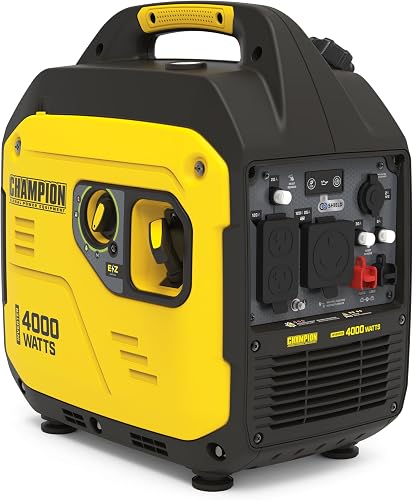

WEN vs Champion inverter generator: which is better?
The Champion suits smaller loads and frequent loading, while the WEN suits buyers who need more continuous power and can manage a heavier unit. Buy enough output for your actual equipment before choosing around convenience features.
The Champion delivers 3000 running watts and 4000 starting watts. The WEN provides 4000 rated watts and up to 4800 surge watts, giving it more room for ongoing demand and motor startup.
That makes the WEN the stronger option when your planned load exceeds the Champion's continuous capacity. If your equipment fits comfortably within the smaller unit's limits, the Champion's lower weight becomes the more useful advantage.
Neither is a good choice if you need electric start, propane operation or a 240V connection. Both use recoil start and gasoline, and their AC outlets are 120V.
If you're still choosing the generator type, our guide to inverter vs regular generators explains where an inverter fits.
Which WEN vs Champion inverter generator buyer should skip each model?
Skip the Champion if your load calculation already pushes its limits. Regularly switching essential equipment off to prevent overload means you should reconsider the generator size.
Skip the WEN if you can't safely load it into your vehicle. Wheels help after unloading, but they don't solve a high cargo floor, stairs or a narrow storage doorway.
Also skip both if your campsite prohibits generators during the hours you need power. Check operating hours and noise rules before building your trip around either machine.
Which one gives you more usable power?
The WEN gives you more room for simultaneous loads, but usable power depends on both continuous demand and startup surges. A large number on the generator's name doesn't replace an appliance calculation.
Start with a short list of equipment you truly need. For an RV, that might include cooling, refrigeration, lights, charging and an occasional cooking appliance, with some items scheduled separately.
Read each appliance's electrical label or manual for its input demand. If only amps are shown, volts multiplied by amps gives a rough running-watt figure for many loads; motor startup needs require separate checking.
Add the running watts of everything that will be on together. Then account for the startup demand of equipment that may switch on while those other loads remain connected.
For example, 1200 watts of equipment plus a motor that needs 1800 watts to start creates a brief 3000-watt demand. Use the motor's startup figure in place of its running figure during that calculation, rather than counting both.
Leave spare capacity for changing loads instead of planning to sit at the continuous limit. A refrigerator cycling on while someone uses another appliance can change the total without warning.
Our generator sizing guide walks through the calculation. For a smaller WEN alternative, see our WEN 3600-watt inverter review.
Will either run an RV air conditioner?
An RV air conditioner needs a model-specific power check, especially at startup. Don't choose either generator from the air conditioner's size label alone.
Check the air conditioner's running demand, starting requirement and other loads sharing the RV supply. Water heating or cooking equipment may need to stay off while cooling starts.
If you can't confirm those numbers, resolve that before buying. Extra generator capacity helps only when the generator, connection and RV system all support the intended load.
Which is easier to move and store?
The Champion is easier to lift, while the WEN is better suited to rolling across firm ground. Judge portability by the hardest part of your route.
The Champion weighs 48.1 lb, compared with 72.7 lb for the WEN. That difference matters each time you lift a generator into a trunk, truck bed or storage compartment.
The WEN includes onboard wheels and a telescoping pull handle. They're useful on pavement and other firm surfaces, but soft soil, gravel and steps can still require lifting or help.
The Champion measures 17.9 x 11.7 x 19.7 in, while the WEN measures 23.8 x 12.6 x 22 in, in length, width and height. Measure the storage opening as well as the space inside it.
Before buying, trace the whole route: storage shelf, doorway, vehicle and operating spot. Include the return trip, when you're tired and the generator must cool before packing.
For travel-focused alternatives, our best generators for camping guide can help match the equipment to your trip.
How do their RV outlets and other connections compare?
Both have a TT-30R RV outlet, but the WEN offers more individual device connections. Check each outlet's limit alongside the generator's total output.
The Champion has a 120V 25A TT-30R, a 120V 20A household duplex outlet and a 12V automotive-style outlet. It also includes parallel outlets for a compatible setup.
The WEN has a 120V TT-30R, four three-prong 120V household receptacles, a 12V DC receptacle and 2 USB ports. Those extra sockets suit buyers connecting several separate devices.
More sockets don't create more power. Likewise, an RV-shaped receptacle doesn't promise that every appliance inside the RV can run at once.
Pay attention to the Champion's stated RV outlet amperage rather than assuming the plug shape guarantees the full capacity of a campground connection. Adapters also don't increase a generator's output or a cord's capacity.
Use cords rated for the load, length and outdoor conditions. Keep connections dry, inspect plugs for damage and don't run high loads through light household extension cords.
Are they suitable for electronics?
Both are designed to supply clean inverter power for sensitive electronics. Champion specifies less than 3% total harmonic distortion; WEN specifies under 0.3% at no load and under 1.2% at full load.
For most buyers, appliance capacity and portability are the more useful differences here. Clean output still requires sound cords, correct connections and operation within the generator's limits.
Which has the better noise and runtime figures?
The published figures don't guarantee a fair noise or runtime winner because the measurement conditions differ. Choose around your expected load and campsite rules.
Champion specifies 64 dBA from 23 ft. WEN specifies 62 decibels at quarter load, without a measurement distance in these specifications, so the smaller number doesn't prove it will sound quieter beside your campsite.
Noise changes with engine load, distance and surroundings. Avoid placing either unit where exhaust or sound will point toward neighboring tents or RVs.
Champion claims up to 10 hours at 25% load from a full 1.54-gallon tank. WEN claims up to 7 hours at half load from its 1.9-gallon tank.
Those percentages equal different electrical demands: about 750 watts for the Champion and 2000 watts for the WEN. Comparing hours alone would confuse a lighter workload with better fuel efficiency.
Both have an economy mode that adjusts engine operation with demand. Follow the manual's guidance when starting motor loads rather than assuming the same setting suits every appliance.
Plan fuel around your workload and allow time to stop and cool before refueling. If propane storage would suit your routine better, read how a dual fuel generator works.
How should you set up either generator for the first trip?
Prepare the generator before departure, then connect equipment gradually at your destination. Your first setup should include the manual, oil check, fuel plan and a safe operating location.
- Read the startup instructions. Find the oil requirements, controls, grounding directions and maintenance schedule before adding fluids.
- Check oil on level ground. Follow the stated fill method; don't assume a new engine arrives ready to run.
- Choose an outdoor location. Keep the unit at least 20 feet from homes, with exhaust facing away from doors, windows, vents and people.
- Inspect cords and plugs. Match their ratings to the equipment and route them away from heat, water and walking paths.
- Start with loads disconnected. Follow the manual's warmup steps, then connect equipment one item at a time.
- Watch the total demand. If an overload occurs, disconnect loads and follow the reset procedure instead of repeatedly restarting the same combination.
For an RV, check that its supply cord and any adapter match the generator connection. Set appliance controls deliberately so an unnoticed high-draw load doesn't start as soon as you connect.
Never plug a generator into a wall receptacle to feed a house. If you need to power household circuits, our generator transfer switch guide explains the connection planning involved.
What safety features do they include?
Both include carbon monoxide shutdown, which adds protection but doesn't change the outdoor-only rule. Champion uses CO Shield, while WEN uses its Watchdog CO Shutdown Sensor.
Don't run either generator inside a garage, shed, tent, vehicle or enclosed RV compartment. An open garage door doesn't make indoor operation safe.
Keep working carbon monoxide alarms in occupied buildings and RVs as appropriate. If an alarm sounds or anyone feels ill, move to fresh air and seek emergency help.
If a generator's CO system stops the engine, leave it off while you address placement and exhaust conditions according to the manual. Don't keep restarting it in the same position.
Champion also includes low-oil shutdown. That feature doesn't replace checking the oil, and you should never bypass a safety system to keep equipment running.
Rain creates a separate electrical hazard. Follow the manual's weather instructions and use only a suitable operating shelter that preserves ventilation and required clearances.
Our guide to generator carbon monoxide risks explains why distance and exhaust direction matter.
What care matters between camping trips?
Fuel care and scheduled oil service matter more than occasional cleaning for keeping either gasoline generator ready. Record engine use and follow the manual's service intervals.
The WEN's fuel shutoff stops fuel flow and lets the engine use the remaining fuel in the carburetor. That helps reduce stagnant fuel there, but it doesn't empty the tank or replace the full storage procedure.
For the Champion, follow its manual's shutdown and storage steps rather than assuming it has the same fuel feature. Storage instructions may change depending on how long the generator will sit unused.
Use fresh fuel that meets the engine's requirements. If the manual calls for fuel stabilizer during storage, use the correct amount and procedure rather than adding it to old fuel and expecting a repair.
Check the air filter, oil and other service items on schedule. Dusty conditions can require more attention, so read the maintenance notes for your operating environment.
Before shutting down, disconnect equipment and follow the cooling instructions. Never add gasoline to a running or hot engine, and let the unit cool before transport or storage.
WEN vs Champion inverter generator: which should you choose?
Choose Champion when your load fits and frequent lifting is unavoidable. Choose WEN when the extra continuous capacity solves a real appliance need and you can handle vehicle loading.
For occasional camping with modest demands, favor the generator that's easier to bring and set up. For RV use with several necessary loads, calculate those loads first and accept extra weight only when it buys useful capacity.
Don't choose the Champion as the center of an emergency home backup plan: Champion doesn't recommend this model for that role. Don't choose the WEN simply to cover an appliance list you haven't measured.
Finish your WEN vs Champion inverter generator decision with 3 checks: required power, the hardest lift and the correct connection. If neither fits all 3, browse our best inverter generators guide for a different size or setup.
Frequently asked questions
Is WEN or Champion better for an RV?
Choose Champion for frequent lifting and WEN for larger appliance loads; both have a TT-30R RV connection, but the connector alone doesn't tell you which appliances can run together. Add their running demands, allow for motor startup, and check the generator outlet, RV cord and RV electrical limits.
Which inverter generator is easier to move?
The Champion is easier to lift because it weighs 48.1 lb, compared with the WEN's 72.7 lb; the WEN has wheels and a telescoping handle for rolling across firm ground. Choose around your hardest move, such as lifting into a vehicle, rather than the easiest part of the route.
Do both generators have carbon monoxide shutoff?
Yes, Champion includes CO Shield and WEN includes a Watchdog CO Shutdown Sensor; these systems are backup safety features, not permission to run a generator near people or inside a building. Operate outdoors, at least 20 feet from homes, with exhaust directed away from doors, windows, vents and occupied areas.
Which generator has more running watts?
The WEN provides 4000 rated watts, while the Champion provides 3000 running watts; that extra continuous capacity helps when several appliances must operate together. Starting capacity is a separate limit, so a motor's startup demand still needs to fit alongside equipment that is already drawing power.
Can I connect either generator in parallel?
The Champion supports connection to another 4000-watt Champion inverter through an optional parallel kit; use the compatible equipment and connection steps specified for the model. Don't assume the WEN supports the same arrangement or that these two brands can connect together; confirm compatibility before buying any parallel equipment.


