11 Best Inverter Generators (November 2026)
The best inverter generators include the Champion 4000W Dual Fuel RV Inverter for flexible RV trips, the WEN 3600W Dual Fuel RV Inverter (DF360iX) for propane camping trips, and the WEN 4800W Dual Fuel RV Inverter (DF480iX) for frequent RV stays.
On this page (6 sections)
The Champion 4000W Dual Fuel RV Inverter is the best inverter generator for RV and camping buyers who want fuel flexibility without a large wheeled unit. Choose a smaller model for light device loads, or a larger 240V model for a planned home backup setup.
Start with what you'll run together, how you'll move the generator and which fuel you'll actually use. Those choices matter more than the biggest wattage number on the case.
Our picks at a glance
-
1

-
2
 Best for propane camping trips
WEN 3600W Dual Fuel RV Inverter (DF360iX)
8.7/10 our score
See it on Amazon -
3
 Best for frequent RV stays
WEN 4800W Dual Fuel RV Inverter (DF480iX)
8.6/10 our score
See it on Amazon
- 4
 Best for gasoline camping tripsCheck it
- 5
 Check it
WEN 6800W Dual Fuel RV Inverter (DF680iX)
Best for larger mixed loads - 6
 Check it
WEN 4800W RV Inverter (56477i)
Best for longer campsite stays - 7
 Check it
Westinghouse 8200W Tri-Fuel Inverter
Best for home backup planning - 8
 Check it
Champion 2500W Ultralight Inverter
Best for light camping loads - 9
 Check it
Westinghouse iGen1500c 1500W Inverter
Best for small device loads - 10
 Check it
WEN 4800W Electric Start RV Inverter (56480iX)
Best for easier campsite starts - 11
 Check it
WEN 3600W RV Inverter (56360iX)
Best for occasional RV trips
How we chose the best inverter generators
We compared usable output, fuel choices, connections and portability to find models for different loads. Safety features and storage needs also shaped each recommendation.
A higher score reflects a stronger fit for this roundup's buyers, not greater capacity. The smaller top picks suit portable RV use, while the larger models serve buyers willing to manage more weight.
Start with the inverter generator guide for how the design works. The inverter vs regular generator comparison explains when a conventional generator may suit your needs.
Compare the best inverter generators
Compare running watts on your intended fuel before peak output. Then check whether the outlets, voltage and carrying weight fit your setup.
Running watts cover steady demand; starting watts cover a brief surge. Neither figure lets you exceed an individual outlet's limit.
| Product | Best for | Running watts | Fuel | Weight | Our score |
|---|---|---|---|---|---|
| Champion 4000W Dual Fuel RV Inverter | flexible RV trips | 3,000 gas; 2,700 propane | Gasoline or propane | 51.8 lb | 8.8 |
| WEN 3600W Dual Fuel RV Inverter (DF360iX) | propane camping trips | 2,900 gas; 2,600 propane | Gasoline or propane | 49 lb | 8.7 |
| WEN 4800W Dual Fuel RV Inverter (DF480iX) | frequent RV stays | 4,000 gas; confirm propane output | Gasoline or propane | 78.5 lb | 8.6 |
| Champion 4000W RV Inverter | gasoline camping trips | 3,000 | Gasoline | 48.1 lb | 8.5 |
| WEN 6800W Dual Fuel RV Inverter (DF680iX) | larger mixed loads | 5,100 gas; 4,500 propane | Gasoline or propane | 99.2 lb | 8.5 |
| WEN 4800W RV Inverter (56477i) | longer campsite stays | 4,000 | Gasoline | 72.7 lb | 8.3 |
| Westinghouse 8200W Tri-Fuel Inverter | home backup planning | 6,600 gas; 5,940 propane; 5,280 natural gas | Gasoline, propane or natural gas | 134.5 lb | 8.3 |
| Champion 2500W Ultralight Inverter | light camping loads | 1,850 | Gasoline | 39.7 lb | 8.1 |
| Westinghouse iGen1500c 1500W Inverter | small device loads | 1,000 | Gasoline | 8.0 | |
| WEN 4800W Electric Start RV Inverter (56480iX) | easier campsite starts | 4,000 | Gasoline | 77 lb | 8.0 |
| WEN 3600W RV Inverter (56360iX) | occasional RV trips | 2,900 | Gasoline | 46.3 lb | 7.9 |
Which inverter generator fits your needs?
Choose the Champion dual-fuel 4000W model for a balanced RV setup, then move smaller or larger according to your load. The differences below show when each alternative earns its place.
Champion 4000W Dual Fuel RV Inverter: Best for flexible RV trips
- Gasoline or propane
- TT-30R RV outlet
- Recoil start
- CO Shield auto shutoff
A balanced choice for RV travelers who want two fuel options without moving to a wheeled generator. Size your appliances around its lower propane output if that's your main fuel.
Pros
- Two fuel choices
- RV TT-30R outlet
- CO Shield auto shutoff
Cons
- Lower running output on propane
- Parallel kit sold separately
This Champion suits RV travelers who want to use gasoline on one trip and propane on another. Its TT-30R outlet makes the RV connection straightforward, provided the trailer's actual demand fits the generator.
You get 3,000 running watts on gasoline or 2,700 on propane. Plan around the propane limit if that's your normal fuel, rather than treating gasoline output as capacity you'll always have available.
At 51.8 lb, it remains a lifting job when loading a vehicle. Include fuel containers, cords and the propane cylinder in your packing plan, not just the generator itself.
Choose it for mixed camping and RV use with modest appliance needs. Skip it if you want electric start, need 240V equipment, or cannot safely lift this size; Champion's compatible parallel option also requires a separate kit.
WEN 3600W Dual Fuel RV Inverter (DF360iX): Best for propane camping trips
- Gasoline or propane
- Tool-free LPG quick-connector
- Fuel shutoff
- CO Watchdog sensor
This WEN suits campers who want propane operation and an RV outlet in a smaller package. Its fuel shutoff also helps clear gasoline from the carburetor before storage.
Pros
- Tool-free propane connector
- 49 lb weight
- Fuel shutoff and CO sensor
Cons
- Lower running output on propane
- Less output than the larger dual-fuel WEN models
The DF360iX fits campers who want propane flexibility and can keep their simultaneous loads modest. Its tool-free LPG quick-connector helps with setup, while the RV outlet avoids relying solely on household receptacles.
It provides 2,900 running watts on gasoline or 2,600 on propane in a 49 lb package. The two USB ports are useful for small devices without occupying the main AC outlets.
Fuel shutoff lets the engine consume gasoline remaining in the carburetor before stopping. That helps reduce stale-fuel buildup, though it does not replace the rest of WEN's storage instructions.
Choose it when this capacity covers your trip and carrying weight matters. Skip it if an air conditioner plus other appliances leaves little reserve, or if you need the electric starter offered by the larger dual-fuel WEN.
WEN 4800W Dual Fuel RV Inverter (DF480iX): Best for frequent RV stays
- Gasoline or propane
- Electric start with recoil backup
- Wheels and telescoping handle
- CO Watchdog sensor
Electric start and a wheeled frame suit RV users who move the generator into position rather than carry it far. Confirm continuous propane output with WEN before planning a load near its limit.
Pros
- Electric start and recoil backup
- Dual-fuel operation
- Wheels and telescoping handle
Cons
- Heavy for vehicle loading
- Propane running-watt figures conflict
The DF480iX suits regular RV users who want electric start and more gasoline capacity than the smaller carry models. Its recoil backup gives you another starting method if the electric starter isn't available.
Gasoline output is 4,000 running watts, with four household receptacles for distributing compatible plug-in loads. Those extra outlets share the generator's capacity; they do not each receive the full output.
WEN's propane running-watt figures conflict, so confirm continuous propane capacity with WEN before choosing it for a load near the limit. Don't build a propane plan around its gasoline number.
Wheels and a telescoping handle help on suitable ground, but its 78.5 lb weight still matters at steps and vehicle cargo floors. Skip it for frequent solo lifting or if dependable sizing on propane is essential before you can confirm that figure.
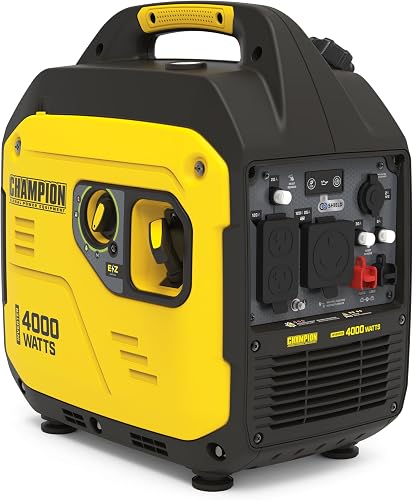
Champion 4000W RV Inverter: Best for gasoline camping trips
- Gasoline operation
- TT-30R RV outlet
- Recoil start
- CO Shield auto shutoff
Choose this Champion for RV and camping use when you already plan to carry gasoline. Champion does not recommend this model for emergency home backup.
Pros
- Lighter than the dual-fuel Champion
- RV TT-30R outlet
- CO Shield auto shutoff
Cons
- Gasoline only
- Not recommended for emergency home backup
The gasoline-only Champion fits campers who already carry gasoline and want useful RV capacity without the dual-fuel model's extra weight. It delivers 3,000 running watts and weighs 48.1 lb.
Its TT-30R outlet suits a compatible RV connection, while recoil starting keeps the starting routine manual. Champion rates noise at 64 dBA from 23 ft, so check campsite rules rather than assuming inverter power is welcome everywhere.
Choose it when propane would add equipment you don't plan to use. The smaller WEN gasoline model is another option if its slightly lower output covers your appliances.
Champion does not recommend this model for emergency home backup. Skip it for that role, and review the generator transfer switch guide before choosing equipment intended to supply household circuits.
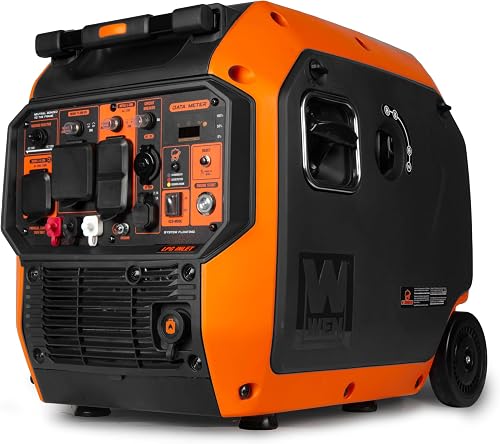
WEN 6800W Dual Fuel RV Inverter (DF680iX): Best for larger mixed loads
- Gasoline or propane
- 120V/240V L14-30R outlet
- Electric start
- CO Watchdog sensor
The DF680iX suits buyers who need more capacity or a compatible 240V connection. Its weight calls for a clear loading and storage plan.
Pros
- Higher output than the smaller WEN models
- 120V/240V outlet
- Electric start and CO sensor
Cons
- Heavy for frequent lifting
- Lower running output on propane
The DF680iX is the step up for buyers who need higher output or a compatible 240V connection. Its L14-30R receptacle adds a connection option absent from the smaller 120V RV models.
Running capacity is 5,100 watts on gasoline or 4,500 on propane. That gives you more room for combined loads, but you still need to account for motor startup and each outlet's limits.
WEN describes its bonded-neutral 240V configuration as supporting low-power Level 2 charging for battery and hybrid electric vehicles. Confirm compatibility with the vehicle and charging equipment before making that your reason to buy.
Electric start, wheels and a telescoping handle help with use, but its 99.2 lb weight needs a loading plan. Skip it for light device charging or frequent carrying; choose it when the additional capacity solves a specific load requirement.
WEN 4800W RV Inverter (56477i): Best for longer campsite stays
- Gasoline operation
- Recoil start
- Wheels and telescoping handle
- Fuel shutoff and CO Watchdog
This gasoline-only WEN fits a campsite setup where you want more capacity and can roll the generator into place. Choose another model if electric start or propane is a priority.
Pros
- 4,000 running watts
- Fuel shutoff
- RV TT-30R outlet
Cons
- Gasoline only
- Recoil start
The 56477i suits longer campsite stays where you want 4,000 running watts on gasoline and can roll the generator from storage. It uses recoil start, making it the manual-start alternative to the 56480iX below.
WEN gives up to 7 hours of runtime at half load from its 1.9-gallon tank. Use that as a planning reference, with breaks for safe refueling rather than an expectation at every load.
Four household receptacles and a TT-30R RV outlet support different connection needs within the generator's limits. Fuel shutoff helps clear the carburetor when you're finishing a gasoline-powered trip.
Choose it if gasoline and pull starting suit your routine. Skip it if starting effort is a concern, propane is central to your fuel plan, or lifting its 72.7 lb frame would make each outing difficult.
Westinghouse 8200W Tri-Fuel Inverter: Best for home backup planning
- Gasoline, propane or natural gas
- 120V/240V 14-50R outlet
- Remote electric start
- CO sensor
The highest-output option here suits selected home circuits and buyers with a planned fuel connection. Its size makes it a better fit for rolling from storage than regular vehicle loading.
Pros
- Three fuel options
- Home backup connection outlet
- Remote electric start
Cons
- Heaviest pick here
- Lower output on propane and natural gas
The Westinghouse iGen8200TFc suits planned home backup with several selected loads and a suitable electrical connection. It's the highest-output model here and the only one offering natural gas alongside gasoline and propane.
Running output is 6,600 watts on gasoline, 5,940 on propane and 5,280 on natural gas. Base your circuit plan on the fuel you'll use during an outage, including any motor startup needs.
Its 120V/240V 14-50R outlet supports compatible transfer equipment, but the socket's 50A designation does not promise 50 amps at 240V. Remote electric start adds convenience after safe placement and connection.
At 134.5 lb, it suits rolling from accessible storage better than frequent vehicle loading. Skip it for small camping loads, and compare our home backup generator picks if supplying home circuits is your main goal.
Champion 2500W Ultralight Inverter: Best for light camping loads
- Gasoline operation
- Household duplex outlet
- Parallel ready
- CO Shield auto shutoff
A lighter choice for campers who can keep their power needs modest. Champion does not recommend this model for emergency home backup.
Pros
- 39.7 lb weight
- 53 dBA from 23 ft
- CO Shield auto shutoff
Cons
- No built-in TT-30R outlet
- Limited capacity for simultaneous appliances
The Champion 2500W Ultralight suits campers who want less lifting and a deliberately small load. At 39.7 lb, it is easier to accommodate than the larger RV-ready Champion models here.
Its 1,850 running watts require some appliance scheduling. You may need to pause one load before using another, especially with heat-producing appliances or equipment that has a motor.
It has household, automotive-style and parallel outlets, but no built-in TT-30R RV receptacle. A compatible parallel kit is optional, so don't assume the standard unit has the connections or output of a larger RV model.
Choose it for a short list of camping devices after checking their combined demand. Skip it if you expect carefree use of several appliances, and note that Champion does not recommend it for emergency home backup.
Westinghouse iGen1500c 1500W Inverter: Best for small device loads
- Gasoline operation
- Two 120V outlets
- Two USB outlets
- CO sensor
Choose the iGen1500c for a short list of low-draw devices rather than several household appliances. Its handle and USB outlets suit a compact portable setup.
Pros
- Built-in carrying handle
- USB outlets
- Parallel capable
Cons
- Lowest output here
- Gasoline only
The iGen1500c is for buyers whose power plan centers on a few low-draw devices. Its 1,000 running watts and 1,500 peak watts make load discipline essential.
Two USB outlets let you charge small devices while leaving the household outlets available. Westinghouse states noise as low as 52 dBA, which describes a particular operating condition rather than every load.
Choose it when charging, lighting and other modest demands cover the job. Check device labels before adding any heater, cooking appliance or motor-driven equipment that could consume most of its capacity.
Skip it for broad household backup or an RV setup with large appliances. Parallel operation with compatible Westinghouse equipment requires a separate cord, so compare the full two-generator setup against buying a larger unit from the start.
WEN 4800W Electric Start RV Inverter (56480iX): Best for easier campsite starts
- Gasoline operation
- Electric start with recoil backup
- Fuel shutoff
- CO Watchdog sensor
This WEN suits gasoline users who want push-button starting and more capacity than a small carry model. Wheels help with ground movement, but loading still takes planning.
Pros
- Electric start with recoil backup
- 4,000 running watts
- RV TT-30R outlet
Cons
- Gasoline only
- 77 lb weight
The 56480iX fits gasoline users who want push-button starting without adding propane equipment. Its recoil backup provides another starting method, while onboard wheels help move it across suitable ground.
It shares the 4,000-running-watt gasoline capacity of the manual-start 56477i. Choose between them mainly by starting preference and handling needs rather than expecting this model to power a larger load.
Four household receptacles, USB ports and a TT-30R outlet offer several connection choices. Keep their combined demand within generator capacity and avoid treating every socket as a separate power supply.
At 77 lb, it needs a practical route between storage, vehicle and operating spot. Skip it if you want propane flexibility or only need a few small devices; follow WEN's battery care instructions so electric start is ready after storage.
WEN 3600W RV Inverter (56360iX): Best for occasional RV trips
- Gasoline operation
- TT-30R RV outlet
- CO Watchdog sensor
- Fuel shutoff
A straightforward choice for occasional RV trips when gasoline and recoil starting fit your routine. Fuel shutoff is useful when the generator spends time between outings.
Pros
- RV TT-30R outlet
- Fuel shutoff
- Lighter than the larger WEN models
Cons
- Gasoline only
- Recoil start
The 56360iX suits occasional RV trips when gasoline and recoil starting fit your routine. Its 2,900 running watts offer more capacity than the small camping picks without the weight of the larger wheeled WEN models.
At 46.3 lb, it is lighter than the dual-fuel DF360iX. Choose between those two by whether propane is useful enough to justify carrying the extra fuel equipment.
Fuel shutoff helps reduce gasoline left in the carburetor before storage. That matters for occasional use, when the generator may sit between trips rather than run regularly.
Choose it for a moderate RV load with a straightforward fuel plan. Skip it if you need electric start or more appliance overlap, and use the 3000-watt generator guide to work through likely combinations.
How do you choose the right inverter generator?
Choose by load first, then fuel, connections and handling. A generator that meets all four needs is more useful than a larger model that is hard to move or connect.
What size is the best inverter generator for your load?
The best inverter generator size covers your steady demand and the largest likely startup event. Write down the appliances you'll actually use together, not everything you own.
For example, an imaginary 1,600-watt running load might include a motor needing 1,800 watts to start instead of its normal 600 watts. That moment requires about 2,800 watts in total, not just the steady-load figure.
Leave some room for uncertain demand and follow the manual's guidance for altitude or temperature effects. Our guide to choosing the right generator size explains the load estimate in more detail.
Which outlets and voltage do you need?
Match voltage, plug type and available capacity to your equipment. An adapter can change a connection shape, but it cannot create extra watts or turn 120V output into 240V power.
For an RV, include appliances that may turn on in the background, such as battery charging equipment. Our RV generator guide helps match the generator to the camper rather than the shore-power plug alone.
For home circuits, have an electrician confirm transfer equipment, grounding and neutral requirements. Never use a cord that feeds generator power into a household wall outlet.
Should you choose gasoline, propane or natural gas?
Choose fuel based on safe storage and dependable access during the situations you expect. Gasoline needs a storage and rotation plan; propane adds a cylinder and hose to your transport load.
Natural gas can suit a fixed home setup, but it needs a suitable connection and adequate supply. It also ties your plan to that utility remaining available.
Size the load using output on your chosen fuel. Read how dual-fuel generators work before deciding whether the flexibility will help your routine.
How should you compare runtime and noise?
Compare runtime at the same load level, and noise at similar distances and loads. A quarter-load runtime cannot be compared directly with a half-load figure.
Estimate how much of your day needs power, then plan fuel and safe shutdown breaks. A long runtime claim does not remove oil checks, maintenance or refueling limits.
Engine speed and sound can rise as demand increases. Don't choose a generator by its lowest noise figure alone, especially if your normal load will be near its capacity.
How much portability do you really need?
Buy for the hardest move you'll make, not just rolling across a driveway. Vehicle loading, steps, gravel and storage shelves can make wheels much less useful.
Allow room for cords, hoses and fuel containers as well as the generator. If lifting is the main problem, reducing the planned load may be more useful than choosing a larger wheeled model.
Do sensitive electronics require inverter power?
Low-distortion inverter power can suit electronics when voltage and capacity match the equipment's requirements. The Champion models here specify less than 3% THD, and WEN describes clean output for sensitive devices.
Keep required surge protection and use suitable connections. Our inverter generator guide explains the output, while the inverter and regular generator comparison helps you decide which design fits the job.
How should you set up and care for an inverter generator?
Prepare the generator before the trip or outage, with oil, fuel, suitable cords and a safe operating location. Follow the model's manual for assembly, first use, break-in and maintenance intervals.
Choose a safe operating spot
Run fuel-burning generators outdoors, at least 20 ft from your home, with exhaust directed away from doors, windows and vents. Keep exhaust away from RVs, tents and neighboring occupied spaces too.
Never run one in a garage, home or RV, even with doors open. Use working indoor CO alarms; automatic generator shutoff adds protection but cannot make an unsafe location acceptable.
Keep the generator dry without enclosing it or blocking airflow. Read about generator carbon monoxide risks and generator use in rain before choosing a weather setup.
Connect loads in a planned order
Check oil on level ground and inspect cords, plugs and fuel connections before starting. Use outdoor-rated extension cords sized for the load and distance, with intact grounding connections.
Start according to the manual, then add loads in stages. Avoid starting several motor-driven appliances together, and follow the model's economy-mode instructions when startup demand is high.
If overload protection trips, disconnect loads and correct the cause before restarting. Repeated resets are a sign to reduce demand, not a way to gain more capacity.
Shut down and store it correctly
Disconnect loads and follow the manual's shutdown sequence. Stop the engine and let it cool before refueling; never add gasoline to a running or hot generator.
Record operating hours so oil changes and other service don't depend on memory. Fuel shutoff helps clear the carburetor, but filters, spark plugs and oil still need scheduled care.
Follow storage instructions for gasoline, propane connections and starter batteries where fitted. Before the next trip, check the generator and accessories early enough to fix a problem without rushing.
Which best inverter generator pick should you buy?
Choose your best inverter generator by eliminating models that fail your load, fuel or handling needs. Then pay attention to the feature that will affect every use, such as carrying weight or starting effort.
Pick the dual-fuel Champion 4000W for flexible RV travel, the DF360iX for a smaller propane-capable setup, or a WEN 4800W model when additional capacity and your preferred starting method matter.
Choose the Champion 2500W or Westinghouse iGen1500c only when your load plan stays small. Move to the DF680iX for suitable higher-output needs, or the tri-fuel Westinghouse for a planned home connection.
Before buying for household circuits, use the generator transfer switch guide to prepare for an electrician's assessment. Confirm the connection and safe placement before the first outage.
Our top 3 picks at a glance
-
1
-
2
Best for propane camping trips
WEN 3600W Dual Fuel RV Inverter (DF360iX)
8.7/10 our score
See it on Amazon -
3
Best for frequent RV stays
WEN 4800W Dual Fuel RV Inverter (DF480iX)
8.6/10 our score
See it on Amazon
Frequently asked questions
What size inverter generator do I need?
Choose enough running capacity for the devices you'll use together, plus enough surge capacity for motor startup while other devices remain on. Use appliance labels and manuals rather than broad household estimates.
Our generator sizing guide explains how to build a load plan before choosing a model.
Can an inverter generator run an RV air conditioner?
Yes, if the generator can meet the air conditioner's startup and running needs alongside the RV's other active loads. Check the AC manual, generator output on your chosen fuel and connection requirements.
A TT-30R outlet gives you an RV connection, but it does not guarantee enough power for every air conditioner.
Are inverter generators safe for electronics?
Low-distortion inverter power can suit sensitive electronics when voltage, frequency and capacity meet the equipment maker's requirements. Check those requirements before connecting valuable devices.
Stay within outlet and generator limits, use suitable cords and follow any surge protection guidance for the equipment.
Low THD does not prevent damage from every electrical fault.
Can an inverter generator power a house?
A suitably sized inverter generator can power selected home circuits through correctly installed transfer equipment. Capacity, voltage, fuel choice and appliance startup demand determine which circuits can run together.
Have a qualified electrician confirm the setup and neutral arrangement.
Never connect a generator to a household wall outlet to feed power into the home.
How quiet is an inverter generator?
Noise depends on engine load, distance and the measurement method, so compare sound figures only when their conditions match. A light-load figure does not describe operation near full output.
Check campground rules before buying, and plan a safe location that directs exhaust away from people without placing the generator near neighboring campsites.


