10 Best Dual Fuel Generators (November 2026)
The best dual fuel generators include the Champion 4000W Dual Fuel RV Inverter for RV trips, the WEN 3600W Dual Fuel RV Inverter (DF360iX) for lighter RV loads, and the Westinghouse 13500W Dual Fuel for high-demand home backup.
On this page (7 sections)
- How we chose these dual fuel generators
- Which best dual fuel generator pick fits your setup?
- How do you size a dual fuel generator without overspending?
- How should you plan gasoline, propane and runtime?
- What setup should you finish before the first outage?
- How do you care for a dual fuel generator between uses?
- Which dual fuel generator should you choose?
The Champion 4000W Dual Fuel RV Inverter is our best dual fuel generator for most RV trips because it balances useful output, an RV outlet and carrying weight. For a larger household backup plan, choose the Westinghouse 13500W Dual Fuel after calculating your essential loads.
Gasoline and propane flexibility helps when one fuel is hard to find, but your generator still needs enough capacity on the fuel you use. Start with appliances and connections, then compare size, starting method and fuel storage.
For a quick explanation of the fuel system, read how a dual fuel generator works. If you are deciding whether propane flexibility is worth it, see dual fuel vs gas-only generators.
Our picks at a glance
-
1

-
2
 Best for lighter RV loads
WEN 3600W Dual Fuel RV Inverter (DF360iX)
8.7/10 our score
See it on Amazon -
3

- 4
 Check it
WEN 4800W Dual Fuel RV Inverter (DF480iX)
Best for RV electric starting - 5
 Check it
Westinghouse 6500W Dual Fuel Home Backup
Best for mid-size home backup - 6
 Check it
WEN 6800W Dual Fuel RV Inverter (DF680iX)
Best for mixed RV use - 7
 Best for larger home loadsCheck it
- 8
 Check it
Westinghouse 4650W Dual Fuel RV Ready
Best for basic trailer backup - 9
 Best for campsite electronicsCheck it
- 10
 Check it
Champion 2500W Dual Fuel Inverter
Best for small essential loads
How we chose these dual fuel generators
We compared fuel-specific running output, outlets, portability and starting options to identify useful choices for RV trips and household backup. Safety shutoffs and storage features also shaped each recommendation.
The order favors a clear fit for common needs rather than the largest engine or peak-watt number. A smaller inverter can be the better buy for an RV owner who must lift it into storage.
We kept conflicting specifications out of firm capacity recommendations. The WEN DF480iX needs confirmation of its propane running output before you size LPG loads.
For home connection planning, read whether you need a generator transfer switch. Never run a portable generator indoors or in an enclosed space, and review portable generator carbon monoxide risks before use.
| Product | Best for | Running watts | Fuel | RV outlet | Our score |
|---|---|---|---|---|---|
| Champion 4000W Dual Fuel RV Inverter | RV trips | 3000 gas; 2700 propane | Gasoline or propane | 120V 25A TT-30R | 8.8 |
| WEN 3600W Dual Fuel RV Inverter (DF360iX) | lighter RV loads | 2900 gas; 2600 propane | Gasoline or propane | TT-30R | 8.7 |
| Westinghouse 13500W Dual Fuel | high-demand home backup | 10500 gas | Gasoline or propane | Home connection outlets: 30A and 50A | 8.7 |
| WEN 4800W Dual Fuel RV Inverter (DF480iX) | RV electric starting | 4000 gas; confirm propane output | Gasoline or propane | TT-30R | 8.6 |
| Westinghouse 6500W Dual Fuel Home Backup | mid-size home backup | 5300 gas; 4800 propane | Gasoline or propane | TT-30R | 8.6 |
| WEN 6800W Dual Fuel RV Inverter (DF680iX) | mixed RV use | 5100 gas; 4500 propane | Gasoline or propane | TT-30R | 8.5 |
| Westinghouse 14500W Dual Fuel | larger home loads | 11500 gas | Gasoline or propane | Home connection outlets: 30A and 50A | 8.4 |
| Westinghouse 4650W Dual Fuel RV Ready | basic trailer backup | 3600 gas; 3240 propane | Gasoline or propane | TT-30R | 8.2 |
| BILT HARD 4500W Dual Fuel | campsite electronics | 3500 gas; 3200 propane | Gasoline or propane | TT-30R | 7.9 |
| Champion 2500W Dual Fuel Inverter | small essential loads | 1850 gas; 1665 propane | Gasoline or propane | Household duplex; no TT-30R | 7.1 |
Which best dual fuel generator pick fits your setup?
Choose the Champion 4000W for ordinary RV loads or a larger Westinghouse for a household connection with higher demand. The product notes below explain where each choice fits and when to move on.
Champion 4000W: best dual fuel generator for RV trips
Champion 4000W Dual Fuel RV Inverter: Best for RV trips
- 4000 starting watts on gasoline or propane
- 3000 running watts on gasoline
- 2700 running watts on propane
- 120V 25A TT-30R outlet
- CO Shield auto shutoff
An RV-focused inverter that balances output and carrying weight. Choose it for a planned appliance load rather than unrestricted RV power.
Pros
- RV-ready TT-30R outlet
- Less than 3% THD
- CO Shield auto shutoff
Cons
- Lower running output on propane
- Parallel kit is sold separately
The Champion supplies 3000 running watts on gasoline or 2700 on propane in a 51.8 lb inverter. Its TT-30R outlet is rated 120V 25A, so the familiar RV plug shape does not mean unrestricted 30A service.
Choose it if you can manage a measured appliance load and want a unit you can carry rather than a heavy open-frame machine. Skip it if your RV needs several demanding appliances running together.
Champion claims up to 10 hours on its gasoline tank or 25 hours on a 20 lb propane cylinder, both at 25% load. Plan shorter fuel intervals when running heavier loads.
Its less-than-3% THD output suits electronics, while CO Shield adds an automatic shutdown safeguard. For appliance planning, see what a 3000 watt generator can run.
WEN DF360iX for lighter RV loads
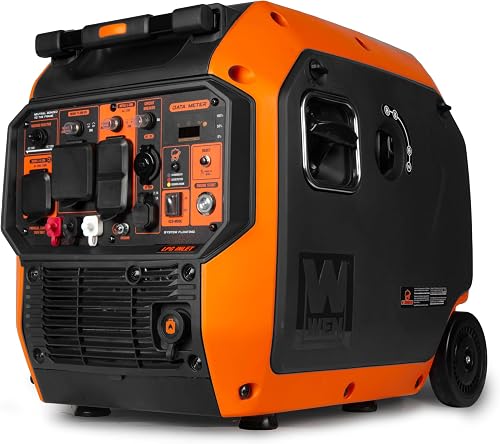
WEN 3600W Dual Fuel RV Inverter (DF360iX): Best for lighter RV loads
- 3600 surge and 2900 rated watts on gasoline
- 3500 surge and 2600 rated watts on propane
- 49 lb weight
- TT-30R RV receptacle
- CO Watchdog shutdown sensor
A lighter inverter for modest RV loads and electronics. Fuel shutoff helps reduce gasoline left in the carburetor before storage.
Pros
- 49 lb weight
- Fuel shutoff
- CO Watchdog shutdown sensor
Cons
- Lower rated output on propane
- Less running output than the Champion 4000W
The WEN DF360iX is a 49 lb inverter with 2900 rated watts on gasoline and 2600 on propane. It suits buyers who carry their generator regularly and can keep the load modest.
Its TT-30R outlet, household receptacles and USB ports cover several connection types. All share one generator capacity, so charging devices while using an RV appliance still counts toward the total.
Fuel shutoff lets the engine use gasoline remaining in the carburetor before stopping. That is useful for occasional use, though it does not replace the manual's fuel-storage steps.
Pick this WEN for a short appliance list and convenient small-device connections. Skip it if your load calculation already approaches its limit before a refrigerator compressor or other motor starts.
WEN gives a quarter-load sound figure without a matching distance here. Use it as context rather than a direct noise ranking.
Westinghouse 13500W for planned household backup
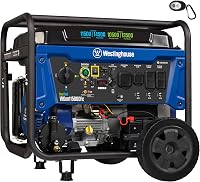
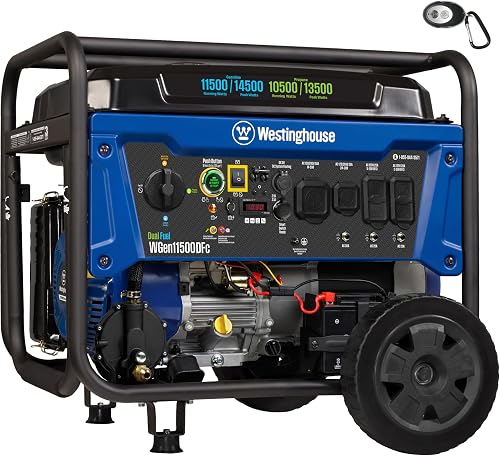
Westinghouse 13500W Dual Fuel: Best for high-demand home backup
- 10500 running watts on gasoline
- Gasoline or propane operation
- Remote key fob and push-button start
- CO sensor shutdown
- 50A and 30A outlets
High gasoline output and home connection outlets suit larger backup plans. Arrange the electrical connection and outdoor operating location before buying.
Pros
- 10500 running watts on gasoline
- Remote key fob start
- CO sensor shutdown
Cons
- 230 lb weight
- Home connection equipment is sold separately
The Westinghouse provides 10500 running watts on gasoline, with 30A and 50A connection options. It fits a household backup plan that exceeds the capacity of the smaller RV inverters.
Push-button and remote starting reduce the effort of starting the engine. They do not remove the need to inspect the generator, check fuel and confirm safe placement before operation.
At 230 lb, this belongs on a planned route between storage and its outdoor operating spot. Wheels, a handle and a lift bracket help, but steps and soft ground still require thought.
Choose it when an electrician-approved connection and appliance calculation justify the capacity. Skip it for frequent campsite loading or a backup list limited to small plug-in devices.
Westinghouse supports pairing it with the separately sold WATS200 automatic transfer switch. Compare the other large option in our Westinghouse 14500 dual fuel generator review.
WEN DF480iX for easier RV starting
WEN 4800W Dual Fuel RV Inverter (DF480iX): Best for RV electric starting
- 4800 surge and 4000 rated watts on gasoline
- 4320 surge watts on propane
- Electric start with recoil backup
- TT-30R RV receptacle
- CO Watchdog shutdown sensor
More gasoline inverter output and electric start suit RV owners moving beyond a smaller unit. Confirm propane running output with WEN before planning LPG loads.
Pros
- Electric start with recoil backup
- Wheels and telescoping handle
- Fuel shutoff
Cons
- Conflicting published propane running figures
- 78.5 lb weight
The WEN DF480iX offers 4000 rated watts on gasoline with electric start and recoil backup. It suits RV owners who want more inverter capacity and prefer a button to routine pull starting.
At 78.5 lb, it is a step up in handling effort from the smaller carry models. Its wheels and telescoping handle help on a suitable path, but lifting it into a vehicle remains a separate task.
WEN publishes conflicting propane running figures of 3600 and 4000 watts. Confirm the correct rating with WEN before relying on it for an LPG load plan.
Choose it if gasoline output and electric starting fit your needs. Skip it if easy one-person lifting is your priority or your propane load depends on the higher disputed figure.
Fuel shutoff and CO Watchdog are included. Our WEN 4800 dual fuel generator review takes a closer look at this model.
Westinghouse 6500W for priority household circuits
Westinghouse 6500W Dual Fuel Home Backup: Best for mid-size home backup
- 5300 running watts on gasoline
- 4800 running watts on propane
- 120/240V selector
- Transfer-switch-ready L14-30R outlet
- CO shutdown
A moderate home backup choice with an RV outlet and a separate household connection option. Match its capacity to priority circuits rather than every appliance.
Pros
- 120/240V selector
- CO and low-oil shutdown
- Fuel gauge
Cons
- 135.6 lb weight
- Household connection needs separate equipment
This Westinghouse provides 5300 running watts on gasoline or 4800 on propane. It is a sensible middle option when selected household essentials need more capacity than a smaller camping inverter offers.
Its 120/240V selector and L14-30R outlet support a properly planned household connection. The separate TT-30R outlet also serves compatible RV equipment.
Choose it for priority circuits you can manage, rather than expecting every appliance to stay on. A pump starting while an electric heating appliance runs can change the capacity you need.
The 135.6 lb weight makes storage access worth checking before delivery. Measure the route, consider thresholds and decide who will move it during an outage.
Skip it if you need the greater output of the large Westinghouse models or a lightweight travel unit. Our home backup generator guide covers load and connection planning.
WEN DF680iX for RV and 240V equipment
WEN 6800W Dual Fuel RV Inverter (DF680iX): Best for mixed RV use
- 5100 rated watts on gasoline
- 4500 rated watts on propane
- 120/240V L14-30R outlet
- Electric start
- CO Watchdog shutdown sensor
An inverter for buyers who need both RV connections and a 120/240V outlet. Its bonded-neutral configuration needs to match the equipment and connection plan.
Pros
- Electric start with recoil backup
- 120/240V outlet
- Fuel shutoff and CO Watchdog sensor
Cons
- 99.2 lb weight
- Lower rated output on propane
The DF680iX delivers 5100 rated watts on gasoline or 4500 on propane. Its L14-30R 120/240V outlet and voltage selector make it useful when your needs extend beyond ordinary RV connections.
WEN describes its bonded-neutral configuration as suitable for low-power Level 2 charging with compatible battery and hybrid electric vehicles. Confirm compatibility with the vehicle, charging equipment and generator instructions before planning that use.
Choose it when you need inverter output and a genuine reason for a 240V connection. Skip it if a smaller 120V model already covers every appliance on your list.
The unit weighs 99.2 lb and includes wheels and a telescoping handle. Electric starting with recoil backup helps with operation, but does not make vehicle loading easier.
For household use, have an electrician confirm that the neutral configuration suits the connection system. Do not alter bonding yourself to make equipment appear compatible.
Westinghouse 14500W for larger household loads
Westinghouse 14500W Dual Fuel: Best for larger home loads
- 11500 running watts on gasoline
- Gasoline or propane operation
- Remote key fob and push-button start
- CO sensor shutdown
- 50A and 30A outlets
The highest gasoline running output here suits a larger household load plan. Its weight and connection needs make it better for planned backup than frequent transport.
Pros
- 11500 running watts on gasoline
- Remote key fob start
- Less than 5% THD
Cons
- 230 lb weight
- Home connection equipment is sold separately
This Westinghouse has the highest gasoline running output here at 11500 watts. Choose it when a detailed load calculation calls for more capacity than the 13500W model provides.
Its 30A and 50A outlets, remote start and push-button start suit a planned home backup installation. The engine uses pressure lubrication and a reusable oil screen, with maintenance still required on the manual's schedule.
Westinghouse specifies less than 5% THD for its output. Check any connected equipment's power requirements rather than assuming capacity alone settles compatibility.
The generator weighs 230 lb, so it needs accessible storage and a practical outdoor placement route. Skip it if you cannot move that weight safely or only need a few low-demand appliances.
Before choosing it for propane backup, confirm its fuel-specific output. Do not carry the headline gasoline figure over to an LPG load calculation.
Westinghouse 4650W for basic trailer backup
Westinghouse 4650W Dual Fuel RV Ready: Best for basic trailer backup
- 3600 rated watts on gasoline
- 3240 rated watts on propane
- TT-30R and L5-30R outlets
- CO shutdown
- 4 gal gasoline tank with fuel gauge
An open-frame choice for buyers who need RV and locking 120V connections. Its substantial weight makes storage access and movement part of the decision.
Pros
- TT-30R and L5-30R outlets
- Fuel gauge
- CO and low-oil shutdown
Cons
- 108 lb weight
- Lower propane running output
The Westinghouse 4650W supplies 3600 rated watts on gasoline or 3240 on propane. Its TT-30R and L5-30R outlets suit buyers who need RV and locking 120V connections.
Choose it if those outlets match your equipment and you have a manageable transport plan. Its 108 lb open-frame design is a substantial load compared with the smaller enclosed inverters.
The 4 gal gasoline tank has a fuel gauge, which helps you plan shutdown and refueling. Automatic low-oil and CO shutdown add safeguards, but normal checks still belong in your routine.
Skip it if you need 240V household equipment or frequent lifting into a vehicle. A locking 30A outlet should not be confused with the 120/240V connection on other models.
Base the appliance plan on running output and motor demand. Avoid choosing this model just because its headline peak number is larger than another generator's continuous rating.
BILT HARD 4500W for campsite electronics
BILT HARD 4500W Dual Fuel: Best for campsite electronics
- 3500 rated watts on gasoline
- 3200 rated watts on propane
- 58 dBA at 23 ft
- Less than 3% THD
- CO sensor shutdown
An enclosed inverter for campers who need electronics power and an RV connection. It offers more running output than the smallest carry-focused choices.
Pros
- Less than 3% THD
- CO sensor shutdown
- Propane hose with regulator included
Cons
- Recoil start
- Parallel kit is sold separately
The BILT HARD combines 3500 rated watts on gasoline or 3200 on propane with an enclosed inverter design. It suits campers who want an RV outlet and power for electronics without moving into the larger wheeled class.
Its output has less than 3% THD, and the connections include household power, USB ports and 12V DC. Check device instructions for the right connection rather than choosing a port only because it fits.
At 57.7 lb, it is heavier than the small Champion and WEN carry models. Choose it when its extra running capacity matters more than the lowest carry weight.
BILT HARD gives a sound figure of 58 dBA at 23 ft. Campground generator hours and placement rules still apply.
Skip it if electric starting is a priority. It uses recoil start, while parallel operation requires a separate kit and a compatible setup.
Champion 2500W for a short essentials list
Champion 2500W Dual Fuel Inverter: Best for small essential loads
- 2500 starting watts on gasoline
- 1850 running watts on gasoline
- 1665 running watts on propane
- 53 dBA at 23 ft
- CO Shield auto shutoff
The lightest choice here suits a short list of essentials and easy transport. Choose a larger model for demanding appliances or a direct RV outlet.
Pros
- 43.2 lb weight
- CO Shield auto shutoff
- Less than 3% THD
Cons
- Lowest running output in this roundup
- Parallel kit is sold separately
The Champion 2500W is the lightest pick at 43.2 lb, with 1850 running watts on gasoline or 1665 on propane. It fits small essentials better than a demanding RV appliance plan.
Choose it for portability when your actual load list stays comfortably within its capacity. A few lights and chargers leave a different margin from a heating appliance or motor-driven tool.
Its covered household duplex supplies less-than-3% THD power, and a regulated automotive-style outlet is included. There is no direct TT-30R connection among its included outlets.
Champion gives a sound figure of 53 dBA at 23 ft. The low weight and sound figure are useful reasons to consider it, but neither adds appliance capacity.
Skip it for high startup loads or several power-hungry devices used together. A separately sold parallel kit offers expansion with compatible equipment, though that also means transporting and maintaining another unit.
How do you size a dual fuel generator without overspending?
Size the generator for loads you need together, using the running rating for your chosen fuel. Then allow for the extra demand of the largest motor likely to start while those loads remain on.
Build a load list around real use
Write down each essential appliance, its voltage, running watts and startup requirement. Use appliance labels and manuals rather than estimates based only on the appliance name.
For example, 1500 watts of ongoing loads plus a motor needing 1200 additional watts at startup creates a 2700-watt momentary demand. That is different from needing 2700 watts continuously.
Reduce unnecessary overlap before buying a larger machine. Turning off a microwave before running another heavy appliance can make a smaller generator practical.
Match voltage and outlets as well as watts
A generator needs the right voltage and connection for the equipment, even when its total wattage appears sufficient. A 120V RV outlet cannot supply a 240V appliance through a simple plug adapter.
For household wiring, review generator transfer switch choices with a qualified electrician. Never feed generator power into a wall outlet or use a cord with exposed male ends.
Each receptacle also has its own current limit. Several outlets do not multiply the generator's capacity, and adapters do not increase an outlet's rating.
Decide whether inverter power helps your equipment
An inverter is useful when you want suitable power quality for electronics in an RV or portable setup. Check the actual distortion specification and equipment requirements rather than choosing by the inverter label alone.
The large open-frame choices here serve higher household loads, while the smaller inverters are easier to transport. Read inverter vs regular generators if you are deciding between those roles.
How should you plan gasoline, propane and runtime?
Choose fuel around storage, availability and your expected load, rather than the longest advertised runtime. Keep enough usable fuel for your essential operating periods and a safe plan for replenishing it.
Compare runtime at similar loads
A runtime measured at 25% load is not a forecast for air conditioning, pumps or several household circuits. Larger appliances can shorten the interval between refueling or cylinder changes.
Tank sizes also differ, so a longer runtime does not automatically mean better fuel efficiency. For propane planning, read how long a generator can run on propane.
Keep both fuel options ready
Propane avoids storing gasoline in the generator's fuel system, but cylinders still need safe storage and enough fuel. Cold conditions and cylinder size can affect vapor supply, so follow the generator manual's recommendations.
Gasoline needs an approved container and the storage care described in the manual. Label stored fuel by date, and do not wait until an outage to discover that your supply needs replacing.
Keep the correct regulator and hose with the generator's accessories. Do not assume another appliance's propane connection is suitable.
What setup should you finish before the first outage?
Finish placement, connection planning and basic maintenance before you need power. A generator that cannot reach a safe operating location is not a workable backup plan.
Choose a safe outdoor operating spot
Operate outdoors at least 20 ft from the home, with exhaust directed away from doors, windows and vents. Keep exhaust away from neighboring buildings and occupied vehicles too.
Follow the manufacturer's instructions and the CDC's generator safety guidance. Use battery-powered or battery-backup CO alarms in the home.
Read how to prevent generator carbon monoxide exposure before setting up. A CO shutoff adds protection but cannot make an enclosed location safe.
Keep the generator dry with a purpose-built, ventilated operating shelter that follows the manual's clearances. Never run it under a storage cover or inside a garage.
Prepare connections before starting
Complete assembly, add the specified oil and follow the manual's first-use procedure. Included oil still needs to be added correctly, and a low-oil sensor does not replace checking the level.
For direct appliance connections, use outdoor-rated cords with enough capacity for the load and length. Inspect plugs and insulation, and keep connections dry.
Connect propane according to the manual and check for leaks using the approved method, never a flame. Start without connected loads when instructed, then add appliances in a controlled order.
Practice a manageable load routine
Start larger motor loads separately instead of switching everything on together. If an overload occurs, disconnect loads and follow the reset procedure rather than repeatedly restarting with the same demand.
Keep the manual, suitable cords and maintenance supplies together. Make sure another household member knows the shutdown steps and which appliances take priority.
How do you care for a dual fuel generator between uses?
Follow the manual's maintenance intervals and storage procedure, including engine care after propane use. Propane operation does not remove the need for oil changes, air-filter care or inspections.
Record operating hours so maintenance does not depend on memory. Check hoses, cords and accessible fittings before use, and maintain the starting battery as directed on electric-start models.
Use fuel shutoff according to the model's instructions when preparing the gasoline system for storage. It helps clear the carburetor but does not automatically empty the fuel tank or complete every storage step.
Shut down and let the engine cool before adding gasoline. Never refuel a running or hot generator, and keep ignition sources away from fuel handling.
Store the generator only after it cools. Keep its operating area clear of leaves, stored fuel and other combustible materials.
Which dual fuel generator should you choose?
The best dual fuel generator is the smallest suitable model that covers your planned loads and connections. Choose the Champion 4000W for an RV-focused balance, or the WEN DF360iX when lower carrying weight matters more than extra output.
Pick the WEN DF480iX for electric starting and more gasoline inverter capacity. Choose the DF680iX when your equipment also needs its 120/240V connection.
For household circuits, select the Westinghouse 6500W for a moderate essentials plan or the 13500W for higher demand. Move to the 14500W only when the load calculation justifies its extra gasoline capacity.
Choose the Champion 2500W for a short portable essentials list. Before ordering any model, finish your fuel-specific load plan using our guide to choosing a generator for home backup.
Our top 3 picks at a glance
-
1
-
2
Best for lighter RV loads
WEN 3600W Dual Fuel RV Inverter (DF360iX)
8.7/10 our score
See it on Amazon -
3
Frequently asked questions
What is the best dual fuel generator for home backup?
The Westinghouse 13500W Dual Fuel is our leading choice for a larger home backup plan, while the Westinghouse 6500W suits a smaller priority-circuit load. Choose after calculating appliance demand and arranging a safe electrical connection; a high peak-watt number alone cannot tell you which household loads can run together.
Do dual fuel generators make less power on propane?
Most models here have lower running output on propane than on gasoline. Use the figure for your intended fuel when adding up appliances, and leave room for motor startup demand; a generator sized tightly around its gasoline capacity may require you to disconnect an appliance when switching to propane.
Are inverter generators better for RV use?
An inverter is a useful RV choice when you want suitable power quality for electronics and an output level that matches your appliances. Check the RV plug, available running watts and motor startup needs together; an RV-ready outlet does not mean the generator can power everything in the trailer at once.
Can a dual fuel generator run on propane during an outage?
Yes, a dual fuel generator can run on propane during an outage when connected and operated according to its manual. Keep a suitable cylinder, regulator and hose ready before power fails; operate outdoors away from buildings, and plan cylinder changes because fuel flexibility does not provide an unlimited fuel supply.
What size dual fuel generator do I need?
Choose a generator that covers your combined running load and the extra demand when a motor starts. Include only appliances you need together, then use the output rating for your chosen fuel; our generator sizing guide explains how to build a load list without buying unnecessary capacity.