Westinghouse 14500 Dual Fuel Generator Review: Worth It? (November 2026)
The Westinghouse 14500 generator suits home backup when you need substantial running power and gasoline or propane flexibility. Choose the Dual Fuel for those 2 fuels, or the Tri-Fuel if you need a natural gas connection.
On this page (10 sections)
- What does the Westinghouse 14500 generator offer?
- How do you work out which home loads it can carry?
- Which fuel should you plan to use?
- Which Westinghouse alternative suits your household?
- What should you arrange before connecting home circuits?
- Where can you safely place and move it?
- How should you prepare for the first start?
- What care helps keep it ready for an outage?
- Which mistakes cause the biggest problems?
- Should you choose the Westinghouse 14500 generator?
The Westinghouse 14500 generator is a strong fit for home backup when your essential loads need substantial power and you want gasoline or propane flexibility. Choose the Dual Fuel model for those fuels, or the Tri-Fuel version if a natural gas connection is part of your plan.
Its main buying question is capacity: can it carry your chosen appliances, including their startup demands? Fuel storage, safe placement and a suitable home connection matter just as much as the number on the frame.
If fuel choice is new to you, start with how a dual fuel generator works.
What does the Westinghouse 14500 generator offer?
The WGen11500DFc delivers 11,500 running watts and 14,500 peak watts on gasoline, with propane as its second fuel. It also includes push-button electric start, a remote key fob and a CO sensor.
Westinghouse 14500W Dual Fuel: Best for larger essential loads
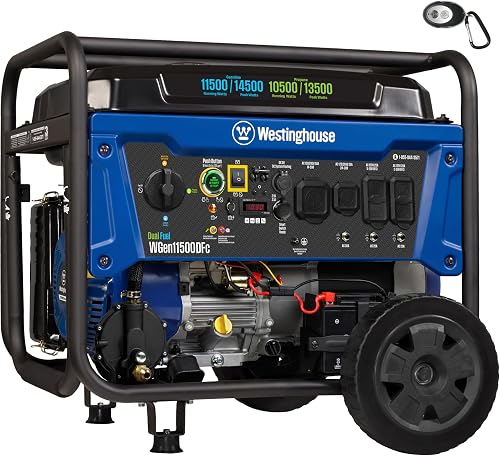
- 11,500 running watts on gasoline
- Gasoline or propane
- Remote electric start
- CO sensor
Fits households with larger essential loads and a plan to use gasoline or propane. Allow room for safe outdoor operation and a clear route from storage.
Pros
- High gasoline running capacity
- Remote key fob and push-button start
- CO sensor and automatic low-oil shutdown
- 30A and 50A outlets for compatible connections
Cons
- Heavy to move at 230 lb
- Confirm propane output before sizing loads
- WATS200 automatic transfer switch sold separately
Its 550cc, four-stroke engine uses pressure lubrication and a reusable oil screen. Automatic low-oil shutdown helps protect the engine, while a fuel gauge and hour meter support routine checks.
Westinghouse claims up to 19 hours at 25% load from the 9.5-gallon gasoline tank. Treat that as a light-load benchmark, rather than a refueling schedule for heavy home backup.
The generator also has less than 5% total harmonic distortion, or THD, a measure of power waveform distortion. That makes it worth considering for a backup plan that includes computers and TVs alongside household appliances.
Who should buy the Westinghouse 14500 generator?
Buy it if you have several essential circuits to support, room for safe outdoor operation and a practical fuel plan. It suits a household willing to manage appliance use during an outage rather than assume every circuit can run together.
Skip it if you only need a few lights, phone charging and one modest appliance. A smaller generator may meet that need with less equipment to move and store.
It also deserves a second look if quiet operation is your main concern. These are open-frame generators; compare the different design and operating needs in our inverter generator guide before choosing.
How do you work out which home loads it can carry?
Build a running-load total plus startup allowance before deciding whether this generator is large enough. Peak output handles brief starting demands and cannot serve as your continuous power budget.
Use appliance labels and manuals to make a short worksheet:
- Record the running watts of everything you want on together.
- Note startup requirements for motors and compressors.
- Identify loads that cycle on without warning, such as a refrigerator or sump pump.
- Mark optional appliances you can leave off or use separately.
For example, 6,000 watts of running loads plus a motor needing 3,000 additional watts at startup creates a brief 9,000-watt demand. This is a sizing example, not a promise about any particular appliance.
Leave room for automatic loads to start while other equipment is operating. A plan that depends on nobody using an extra appliance is harder to manage during a long outage.
Large heating appliances and central cooling equipment deserve special attention. Have an electrician assess their requirements instead of assuming the generator's peak number covers them.
Our generator sizing guide explains the calculation in more detail. The portable generator guide helps you compare generator types once you know your load target.
Which fuel should you plan to use?
Choose the fuel you can store, connect and replenish reliably during the outages you expect. Gasoline capacity figures do not tell you the available output on propane or natural gas.
Gasoline needs a rotation and storage plan so the generator is not left depending on old fuel. Follow the manual's directions for fuel treatment and storage, and use approved containers.
Propane offers a separate fuel reserve, but cylinder size and fuel availability still matter. Keep cylinders upright, follow connection instructions and check connections for leaks using the prescribed method.
Confirm propane output before finalizing your appliance list. For a longer outage, also plan how you'll replace or refill cylinders rather than relying on one tank without a runtime estimate.
Natural gas makes sense only with the Tri-Fuel model and a suitable supply connection. Have a qualified installer confirm required pressure, flow and connection equipment before you choose that route.
Never attempt a fuel conversion based on a similar model name. For cylinder planning, read how long a generator runs on propane.
Which Westinghouse alternative suits your household?
Choose the Tri-Fuel for natural gas access and the 13500W Dual Fuel when its lower capacity covers your essential loads. Neither alternative provides a weight advantage over the main model.
| Model | Gasoline output | Fuel choices | Best reason to choose it |
|---|---|---|---|
| Westinghouse 14500W Dual Fuel | 11,500 running / 14,500 peak watts | Gasoline, propane | Larger loads without a natural gas plan |
| Westinghouse 14500W Tri-Fuel | 11,500 running / 14,500 peak watts | Gasoline, propane, natural gas | A planned natural gas connection |
| Westinghouse 13500W Dual Fuel | 10,500 running / 13,500 peak watts | Gasoline, propane | A load list within its lower capacity |
The Tri-Fuel WGen11500TFc suits households preparing a natural gas hookup while retaining other fuel options. It shares the main model's engine size, low-THD specification and light-load gasoline runtime claim.
Skip it if you have no realistic natural gas connection plan. The extra fuel option is useful when you can use it, and its gasoline capacity does not exceed the Dual Fuel model's.
The 13500W Dual Fuel WGen10500DFc uses a 500cc engine and adds backup recoil starting alongside electric and remote start. It suits a carefully limited home backup plan that fits its output.
Skip it if your calculations already approach its running limit or require more startup headroom. Its lower output also does not make it easier to lift or move.
For choices beyond these 3 models, see our best dual-fuel generator guide.
What should you arrange before connecting home circuits?
Arrange a compatible inlet and transfer setup with an electrician before relying on the generator for home circuits. The generator has 30A and 50A outlets for suitable connection equipment.
Your electrician should match the generator, cord, inlet, panel and transfer equipment as one system. A higher-capacity generator cannot push more power through a connection than that connection safely allows.
A manual transfer switch or properly installed interlock keeps generator power separated from utility power. Never connect the generator to house wiring through a wall outlet.
Westinghouse supports pairing these models with its WATS200 automatic transfer switch, which is sold separately. Buying the generator alone does not create automatic home backup.
Discuss grounding and neutral requirements for your exact setup with the installer. Those details depend on the generator and how it connects, so avoid changing wiring based on general advice.
Read whether you need a generator transfer switch before choosing connection equipment. Agree on which circuits you'll power so the installation matches your load plan.
Where can you safely place and move it?
Plan for 230 lb and a safe outdoor operating spot before ordering. All 3 models weigh the same, and the main Dual Fuel model measures 28.9 in long, 29.6 in wide and 26.9 in high.
Its wheels and handle help with movement, but steps, gravel and soft ground can still make the route difficult. Measure gates and turns, and arrange suitable help for unloading or changes in level.
Keep the operating spot level and clear of combustible material. The machine's dimensions describe storage space, not the clearances it needs while running.
Operate outdoors, at least 20 feet from the home, with exhaust directed away from doors, windows and vents. Keep it away from neighboring buildings and openings too.
Never use a garage, even with the door open. Our guide explains why garage use is unsafe.
Plan weather protection before an outage arrives. Read whether a generator can run in the rain and follow the manual rather than building an enclosure that traps heat or exhaust.
How should you prepare for the first start?
Complete assembly, oil checks and fuel setup before connecting loads. Follow the manual for the correct sequence, required oil and any initial operating instructions.
Make sure the starting battery is ready according to its care instructions. Learn the controls in daylight so you're not figuring out fuel selection or shutdown steps during an outage.
Use a simple start-up routine:
- Place the generator safely outdoors and inspect it for damage or leaks.
- Check oil and fuel with the engine off as directed.
- Confirm cords and connections are suitable and undamaged.
- Start using the manual's sequence, then add loads as instructed.
- Watch for overload warnings and remove optional loads when needed.
Remote start is useful only after these physical checks are complete. Don't use the key fob to start a generator sitting in storage or with a cover still fitted.
For shutdown, remove loads in the prescribed order and follow the fuel-specific stopping procedure. Let the engine cool before refueling, moving it into storage or covering it.
What care helps keep it ready for an outage?
Use the hour meter and a written service log to track maintenance. Follow the manual's calendar and operating-hour intervals, whichever applies first.
Check oil as directed and service the reusable oil screen on schedule. Pressure lubrication and low-oil shutdown do not replace oil changes or routine inspections.
Keep air intake areas clear and service the air filter according to the operating conditions. Dusty use may require closer attention than clean, occasional backup use.
After an outage, record operating hours, replenish supplies and follow the storage procedure. Address leaks, damaged cords or starting problems before putting the generator away.
For gasoline storage, follow the manual's directions on fuel treatment, draining and storage duration. Keep the battery ready using the recommended charging method rather than waiting until the next outage.
Which mistakes cause the biggest problems?
The biggest mistakes are confusing peak power with running capacity and buying before planning the connection. Both can leave you with a capable generator that does not serve your actual backup needs.
Avoid these other common errors:
- Carrying gasoline output figures over to another fuel.
- Expecting the light-load runtime claim while powering heavy loads.
- Assuming a 50A outlet means every home circuit can run together.
- Choosing the smaller model expecting a lighter machine.
- Refueling while the engine is running or still hot.
The CO sensor is another feature to understand correctly. It shuts down the generator when excess carbon monoxide is detected, but it cannot make unsafe placement acceptable.
Keep working CO alarms inside your home and never ignore an alarm or shutdown. Read about generator carbon monoxide risks before your first use.
Should you choose the Westinghouse 14500 generator?
Choose the Westinghouse 14500 generator in Dual Fuel form when your load worksheet calls for its capacity and gasoline or propane fits your fuel plan. Choose the Tri-Fuel when you can arrange a suitable natural gas connection.
Pick the 13500W Dual Fuel when its lower output still leaves enough room for your running loads and startup demands. Skip this size class if a much smaller generator covers your needs or you cannot provide a safe operating location.
Before ordering, settle 3 things: your fuel-specific load budget, the route to a safe outdoor spot and the equipment needed for home connection. Those decisions determine whether this generator fits your household.
For another nearby option, read our Westinghouse 12500 Tri-Fuel review.
External references: Westinghouse generator support and manuals and CDC carbon monoxide safety.
Frequently asked questions
How many running watts does the Westinghouse 14500 dual fuel generator provide?
The Westinghouse 14500W Dual Fuel provides 11,500 running watts and 14,500 peak watts on gasoline. Use the running figure for ongoing loads and allow for appliance startup demands separately; confirm propane output with Westinghouse before building a load plan around that fuel, rather than carrying over the gasoline figures.
Can the Westinghouse 14500 dual fuel generator run on natural gas?
Choose the Westinghouse 14500W Tri-Fuel if you need natural gas; the Dual Fuel model is the gasoline-and-propane choice. For a natural gas installation, confirm the exact model, fuel-specific output, connection requirements and available gas supply with Westinghouse and a qualified installer before buying connection equipment.
Does the Westinghouse 14500W Dual Fuel have a carbon monoxide shutoff?
Yes, its CO sensor shuts down the generator when excess carbon monoxide is detected. Operate it outdoors, at least 20 feet from the home, with exhaust directed away from doors, windows and vents; the sensor does not replace safe placement or working carbon monoxide alarms inside your home.
Can this generator connect to a home's transfer switch?
Yes, its 30A and 50A outlets support compatible transfer equipment, including an interlock kit, manual transfer switch or Westinghouse WATS200 automatic transfer switch system. Have a qualified electrician confirm the panel, inlet, cord and equipment match; the WATS200 is sold separately, so automatic backup needs more than the generator alone.


