9 Best Quiet Generators (November 2026)
The best quietest portable generators include the Champion 4000W RV Inverter for compact RV setups, the WEN 4800W RV Inverter (56477i) for power-heavy RV trips, and the Champion 2500W Ultralight Inverter for noise-conscious campers.
On this page (6 sections)
The Champion 2500W Ultralight Inverter is our quietest generator recommendation for smaller camping loads, based on its low stated sound figure at a known distance. Choose the Champion 4000W RV Inverter if you need more output and an RV connection.
There is no proven loudness winner across this group because the brands report sound under different conditions. Our top-scoring model balances power, carrying weight and connections; the order is not a quietest-to-loudest ranking.
Start with portable generator types and how they differ if you're still choosing a category. Our guides to generators for RVs and camping generators cover those uses in more detail.
Our picks at a glance
-
1
-
2

-
3
 Best for noise-conscious campers
Champion 2500W Ultralight Inverter
8.1/10 our score
See it on Amazon
- 4
 Check it
Westinghouse iGen1500c 1500W Inverter
Best for charging-focused trips - 5
 Check it
WEN 4800W Electric Start RV Inverter (56480iX)
Best for easier RV starts - 6
 Check it
WEN 3600W RV Inverter (56360iX)
Best for occasional camper trips - 7
 Best for longer camping sessionsCheck it
- 8
 Check it
WEN 4500W RV Inverter (56432iX)
Best for monitoring RV power - 9
 Best for frequent light-duty useCheck it
Which quietest generator candidate fits your trip?
Choose the smaller Champion for noise-focused camping, the larger Champion for compact RV power, or a WEN 4800W model for higher continuous demand. The reviews below explain where each choice fits and when to skip it.
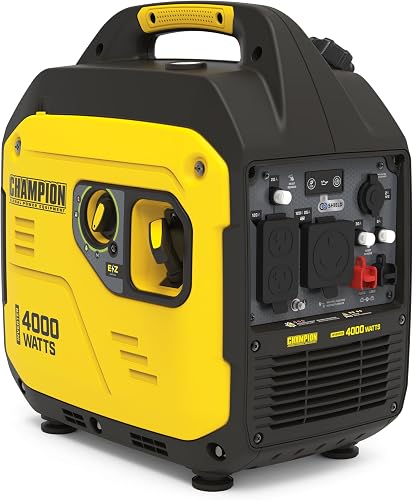
1. Champion 4000W RV Inverter
Champion 4000W RV Inverter: Best for compact RV setups
- 64 dBA from 23 ft
- 3,000 running watts
- 48.1 lb
- CO Shield auto shutoff
Choose this Champion for RV trips when you need more power than a small camping inverter without moving to a heavy wheeled model.
Pros
- TT-30R RV outlet
- Under 49 lb
- CO Shield auto shutoff
Cons
- Higher stated sound level than the smaller Champion
- Champion does not recommend emergency home backup use
The Champion is the strongest fit for RV owners who need useful output without a heavy wheeled body. It supplies 3,000 running watts, weighs 48.1 lb and has a stated sound level of 64 dBA from 23 ft.
Its TT-30R outlet is rated at 120V, 25A. That connector accepts a common RV connection, but it does not turn the generator into a continuous 30A supply.
Choose it for trips where you can manage appliance use, such as pausing a heating appliance while another large load runs. Check motor startup demand before assuming an RV air conditioner will fit.
The optional parallel kit gives you an expansion path with another compatible Champion 4000W inverter. Buying a second unit also means carrying, fueling and maintaining 2 engines.
Skip this model if low sound is more important than capacity, or if your main need is emergency home backup, which Champion does not recommend for it. Read how to choose a generator for an RV or camper before matching it to your trailer.
2. WEN 4800W RV Inverter (56477i)
WEN 4800W RV Inverter (56477i): Best for power-heavy RV trips
- 62 dBA at quarter load
- 4,000 rated watts
- 72.7 lb
- Wheels and telescoping handle
This recoil-start WEN suits buyers who need higher continuous output and can roll the generator between storage and its operating spot.
Pros
- Tied for highest continuous output here
- Wheels and telescoping handle
- Four household receptacles
Cons
- Heavy to lift into a vehicle
- Recoil start
Choose this WEN for a larger equipment list when recoil starting is acceptable. Its 4,000 rated watts provide more continuous capacity than the smaller camping models, and WEN reports 62 dBA at quarter load.
The wheels and telescoping handle help between storage and an operating spot on suitable ground. They do little for lifting its 72.7 lb body over a tailgate or carrying it up steps.
Four household receptacles make it easier to connect separate cords, alongside the RV, DC and USB connections. More sockets do not increase total output, so keep a combined load budget.
WEN claims up to 7 hours at half load from its 1.9-gallon tank. Use that as a planning reference, with a refueling break allowed for heavier demand.
Skip it if every trip involves a solo lift or a long carry over rough ground. The WEN 3600W inverter review covers a smaller alternative when your load permits.
3. Champion 2500W Ultralight Inverter
Champion 2500W Ultralight Inverter: Best for noise-conscious campers
- 53 dBA from 23 ft
- 1,850 running watts
- 39.7 lb
- CO Shield auto shutoff
Our noise-focused camping choice combines a low stated sound figure at a known distance with a body under 40 lb.
Pros
- Low stated sound figure at a known distance
- Easy-to-carry weight class
- Optional parallel expansion
Cons
- Limited capacity for simultaneous appliances
- Champion does not recommend emergency home backup use
This is the pick for campers who put a low stated sound figure ahead of extra appliance capacity. Champion reports 53 dBA from 23 ft, and the 39.7 lb body is easier to carry than the larger RV models.
Its 1,850 running watts suit a planned set of smaller loads rather than unrestricted appliance use. A kettle, heater or cooking appliance can consume much of that capacity by itself.
You get household and automotive-style outlets, but no direct TT-30R RV connection. Choose it for portable equipment rather than buying around an RV plug it does not have.
Champion claims up to 11.5 hours at quarter load, which favors light, steady demand. That figure is not a promise of the same runtime while supplying a demanding appliance.
Skip it for large simultaneous loads, and follow Champion's advice against emergency home backup use. Our guide to inverter generator basics explains why load changes can affect engine speed and sound.
4. Westinghouse iGen1500c 1500W Inverter
Westinghouse iGen1500c 1500W Inverter: Best for charging-focused trips
- As low as 52 dBA
- 1,000 rated watts
- Built-in carrying handle
- CO sensor
Choose the iGen1500c for a short equipment list centered on charging, lights and other small loads.
Pros
- Compact carrying design
- Economy mode
- Compatible parallel expansion
Cons
- Lowest continuous output here
- Sound figure lacks matching distance and load details
The iGen1500c fits trips built around charging devices, lights and a few small electrical loads. Its 1,000 rated watts make it the most limited option here, so write down your equipment needs before choosing its compact size.
Westinghouse reports sound as low as 52 dBA. Without a matching load and distance, that number cannot settle a comparison with the smaller Champion.
Two household outlets and 2 USB outlets suit a charging-focused setup. The built-in handle is useful when your route from the vehicle includes ground where wheels would be awkward.
Parallel capability gives you a way to add output using compatible Westinghouse equipment and the required parallel cord. It is better to size one generator correctly first if you already know you need substantially more capacity.
Skip it for high-draw cooking equipment or motor loads whose startup needs exceed its limits. Use our generator sizing guide before choosing this small an output class.
5. WEN 4800W Electric Start RV Inverter (56480iX)
WEN 4800W Electric Start RV Inverter (56480iX): Best for easier RV starts
- 62 dBA at quarter load
- 4,000 rated watts
- Electric and recoil start
- CO Watchdog shutdown
This WEN fits buyers who want higher RV output and button starting, with wheels for moving it on suitable ground.
Pros
- Electric start with recoil backup
- Tied for highest continuous output here
- Wheels and telescoping handle
Cons
- Heaviest pick here at 77 lb
- Electric starting adds battery care
Choose this model when button starting matters enough to accept more weight. It offers the same continuous output and stated quarter-load sound figure as the recoil-start WEN 4800W above, with recoil backup if needed.
At 77 lb, it is the heaviest generator in this group. Plan the vehicle lift before buying, even if its wheels make movement around a paved campsite straightforward.
Electric start is useful when pulling a starter cord is uncomfortable or inconvenient. It also adds a starting battery to your storage routine, so follow WEN's charging and care instructions between trips.
The four household receptacles and RV connection suit a mixed equipment setup. Decide which appliances can run together before connecting everything simply because sockets remain available.
Skip it if you can comfortably use recoil start and want less weight to lift. For a primary outage setup, compare portable generators for home backup and plan the connection method alongside the generator.
6. WEN 3600W RV Inverter (56360iX)
WEN 3600W RV Inverter (56360iX): Best for occasional camper trips
- 65 dBA at quarter load
- 2,900 rated watts
- 46.3 lb
- Fuel shutoff
A manageable carrying weight, RV outlet and carburetor fuel shutoff suit camper owners who store their generator between trips.
Pros
- TT-30R RV outlet
- Fuel shutoff
- CO Watchdog shutdown
Cons
- Higher stated quarter-load sound figure than larger WEN RV picks
- Recoil start
This WEN suits occasional camper trips where an RV outlet and manageable carrying weight matter. Its 2,900 rated watts come in a 46.3 lb body, giving it a different role from the heavier wheeled models.
Fuel shutoff is useful when the generator spends time stored between outings. It lets the engine consume remaining carburetor fuel before stopping, which WEN says helps limit stale-fuel buildup.
That feature does not remove the need to manage fuel left in the tank. Follow the manual's storage steps rather than treating fuel shutoff as a complete storage procedure.
WEN reports 65 dBA at quarter load, so this is not our first choice for buyers focused mainly on low sound. Choose it because its connection, carrying weight and capacity fit your camper.
Skip it if your appliances need more startup headroom or you want electric starting. Our guide to what a 3000-watt generator can run helps frame a similar power budget.
7. WEN 2800W Inverter (56280iX)
WEN 2800W Inverter (56280iX): Best for longer camping sessions
- 60 dBA at no load
- 2,250 rated watts
- Up to 9 hours at half load
- Fuel shutoff
This WEN suits campers who want more capacity than a small charging generator and a longer claimed half-load runtime.
Pros
- More output than the smaller camping picks
- CO Watchdog shutdown
- Fuel shutoff
Cons
- Noise figure describes no-load operation
- No TT-30R RV outlet
Choose this WEN for camping loads that need more capacity than a small charging generator, with useful runtime between stops. It supplies 2,250 rated watts, and WEN claims up to 9 hours at half load.
Its 45 lb body falls between the smallest carrying models and the larger RV choices. Think about the full trip from storage to vehicle to operating spot, including any stairs.
The household, DC and USB outlets suit individual devices. There is no TT-30R outlet, so it is a better fit for cord-connected equipment than a buyer whose main requirement is a direct RV connection.
WEN's 60 dBA figure describes no-load operation. Do not choose it over a quarter-load-rated model just because that number looks lower.
Skip it if verified sound under working load is your deciding factor. Check your equipment against our generator sizing guide rather than relying on the starting-watt number in the name.
8. WEN 4500W RV Inverter (56432iX)
WEN 4500W RV Inverter (56432iX): Best for monitoring RV power
- 62 dBA at quarter load
- 3,600 rated watts
- Intelligent data meter
- TT-30R RV outlet
Choose this WEN when you want more capacity than the smaller RV models and an onboard data meter.
Pros
- Intelligent data meter
- RV outlet included
- Fuel shutoff
Cons
- Recoil start
- Less continuous output than either WEN 4800W model
This WEN fits RV owners who want 3,600 rated watts and an onboard intelligent data meter. It fills the capacity gap between the smaller RV models and the two WEN 4800W choices.
WEN reports 62 dBA at quarter load, the same stated figure as its larger RV models here. That does not show how the models compare while powering the same appliances.
The RV connection, household outlets and USB ports support a mixed setup. Use the data meter according to the manual, while keeping a separate record of appliance running and startup requirements.
Fuel shutoff and CO Watchdog shutdown are included. Neither changes the need for proper storage, outdoor placement and routine engine service.
Skip this model if electric starting is a priority or your equipment already needs the larger WEN's capacity. If fuel storage is shaping your choice, read how dual-fuel generators work before committing to a gasoline-only model.
9. WEN 2500W Inverter (56250iX)
WEN 2500W Inverter (56250iX): Best for frequent light-duty use
- 65 dBA at quarter load
- 1,900 rated watts
- 37.5 lb
- Onboard hour meter
The light body and hour meter suit buyers who carry a generator often and want help tracking service intervals.
Pros
- Light carrying weight
- Hour meter
- Fuel shutoff
Cons
- Not a leading choice for noise alone
- No TT-30R RV outlet
Choose this WEN for frequent light-duty use when carrying weight and service tracking matter. Its 37.5 lb body includes an hour meter, which helps you track maintenance by engine use rather than memory.
The 1,900 rated watts fit a short, managed equipment list. Moving up slightly in output from the smaller Champion does not create enough extra capacity to change the whole appliance plan.
WEN reports 65 dBA at quarter load, so low weight is the stronger reason to buy it. It is not our preferred choice for a reader whose main goal is the lowest stated sound level.
Two household outlets and 2 USB ports cover smaller devices, without a TT-30R connection. Fuel shutoff is useful before storage, but still follow the full fuel and oil care instructions.
Skip it if you need a direct RV connection or more power for overlapping appliances. Compare use cases in our camping generator guide before prioritizing portability over capacity.
How do you compare quietest generator claims fairly?
Compare sound at the same distance and electrical load before treating a lower dBA number as a win. These figures describe different conditions, so they support a shortlist rather than a precise loudness ranking.
Champion gives a distance for both models, while WEN names no-load or quarter-load conditions. Westinghouse's “as low as” figure describes a minimum rather than sound across every use.
Finding the quietest generator at your actual load
Use your expected working wattage as the comparison point. Quarter load on a larger generator represents more electrical output than quarter load on a smaller one.
For example, a hypothetical 800-watt equipment load uses a much larger share of a 1,000-watt generator's capacity than a 4,000-watt model's. Their engine behavior under that same demand may differ.
Ask for sound information at a comparable distance and working load when noise is the deciding factor. A difference of a few decibels across mismatched conditions is a weak reason to choose one model.
Check the campsite's rules before the sound number
Confirm generator hours and noise limits before buying for a particular campground. A generator advertised as quiet can still be unwelcome during restricted hours.
Nearby walls, vehicles and hard surfaces can reflect sound toward your sitting area or neighboring sites. Choose a safe, open operating position first, then consider where sound travels.
How much power should your quiet generator provide?
Size for running demand plus motor startup, with room for the loads you cannot conveniently switch off. A low sound figure is no help if the generator overloads whenever a compressor starts.
Make a short equipment list with running watts and startup requirements from manuals or appliance labels. Separate essential loads from items you can run briefly on their own.
Suppose your steady loads total 600 watts and another appliance needs 1,200 watts during startup. The generator must support that combined 1,800-watt moment, then carry the ongoing load afterward.
Do not add an appliance's full startup demand twice by also counting its running demand in that same startup calculation. Check how the appliance manufacturer defines each figure.
Start demanding equipment one item at a time instead of allowing several motors to start together. Turn off optional loads before using a kettle, microwave or other high-draw appliance.
Read what a 3000-watt generator can run for examples, then use the generator size guide for your own equipment. Avoid sizing from a generator's model name alone.
How should you set up a quiet generator safely?
Choose a safe outdoor operating spot before connecting equipment. Follow CDC carbon monoxide guidance: stay at least 20 ft from your home and direct exhaust away from doors, windows and vents.
Never operate inside a garage, shed or other enclosed space, even with doors open. Keep exhaust away from tents, RV openings and neighboring occupied areas as well.
CO shutdown is a backup safeguard, not permission to place a generator closer. Working CO alarms and proper placement still matter; read about generator carbon monoxide risks.
Use a stable, level surface and preserve the manufacturer's cooling clearances. Never cover a running generator with a blanket or place it inside a homemade sound box.
Plan for weather without trapping heat or exhaust. Our guide to running a generator in the rain explains the issues to resolve before wet-weather use.
Use outdoor-rated cords sized for their length and load, and keep connections dry. Fully unwind cords as directed and inspect them for damage before starting.
Never feed electricity into a household wall outlet. If you want to supply home circuits, have a qualified electrician plan suitable transfer equipment; our generator transfer switch guide explains that connection.
How do you keep noise and maintenance manageable?
Use only the loads you need, follow the engine service schedule and store fuel correctly. These habits reduce avoidable problems without modifying the exhaust or compromising cooling.
- Use economy mode as instructed. It can reduce engine speed at lighter loads, but follow the manual's guidance for motor starting and sudden demand.
- Keep vents clear. Remove debris when the engine is off and cool, and preserve airflow around the enclosure.
- Track oil service. Check oil as directed and record operating hours, using the onboard meter where available.
- Handle stored fuel properly. Use approved containers and follow the manual's fuel treatment or draining instructions.
- Allow safe refueling breaks. Turn the engine off and let it cool before adding gasoline.
- Keep the unit maintained. Follow the specified air-filter and spark-plug service intervals rather than waiting for starting trouble.
Runtime figures also need context. Quarter-load and half-load claims are not interchangeable, and neither guarantees that the generator will run through your whole trip without attention.
Avoid adding an improvised muffler, blocking an exhaust outlet or surrounding the engine with sound-absorbing material. Buy for a suitable noise level and use safe placement rather than altering the engine.
Which quiet generator should you choose?
Choose by load first, noise conditions second and carrying route third. That order prevents you from buying a quiet model that cannot do the job or reach its operating spot.
Pick the smaller Champion for noise-conscious camping with modest demand. Choose the larger Champion when a compact RV setup needs more capacity, while respecting its restriction against emergency home backup use.
Choose the recoil-start WEN 4800W when higher continuous output matters and you can manage the lift. Move to the electric-start version when easier starting justifies its added weight and battery care.
The Westinghouse fits charging-focused trips; the smaller WEN models serve buyers who favor runtime, carrying weight or maintenance tracking. Choose the WEN 4500W when its RV connection, capacity and data meter match your plan.
The quietest generator for your setup is one that powers your actual equipment without exceeding the noise rules where you use it. Compare the best inverter generators once your load list and safe operating spot are settled.
Our top 3 picks at a glance
-
1
-
2
-
3
Best for noise-conscious campers
Champion 2500W Ultralight Inverter
8.1/10 our score
See it on Amazon
Frequently asked questions
What is the quietest type of generator?
An enclosed inverter generator with load-dependent engine speed is a sensible starting point for low-noise portable power. The quietest generator for you still needs enough running and starting capacity for your equipment.
Compare sound readings at the same distance and actual load before choosing between models.
How quiet is a quiet generator?
These models have stated sound figures from 52 to 65 dBA, measured under different conditions. That range does not form a direct loudness ranking.
Distance, electrical load and nearby surfaces affect what you hear, so check the measurement conditions and your campsite's noise limits before buying.
Is an inverter generator quieter than a regular generator?
An inverter generator can be quieter at lighter loads because many models reduce engine speed as demand falls. A heavy load can still make an inverter generator much louder than its light-load figure suggests.
Our inverter versus regular generator guide explains how engine control and power delivery differ.
Can a quiet generator power an RV?
Yes, if the generator meets your RV's running demand, motor-starting needs and connection requirements. A matching RV outlet helps with connection, but its shape does not guarantee enough power for every appliance together.
Use our guide to choosing a generator for an RV or camper to plan your load.
Can I run a quiet generator near my home?
Keep a portable generator outdoors, at least 20 ft from your home, with exhaust pointed away from doors, windows and vents. Never operate it in a garage, even with the door open.
A quiet engine and CO shutdown cannot replace safe placement; read about generator carbon monoxide risks.


